
Thinking activity for teaching Interpretivism for A Level Sociology

This starter works particularly well because it immediately shows students that the same observable behaviour can be interpreted in very different ways. It introduces one of the central ideas behind interpretivism: that social behaviour cannot always be understood simply by measuring it. Instead, sociologists often need to understand the meanings individuals attach to their actions.
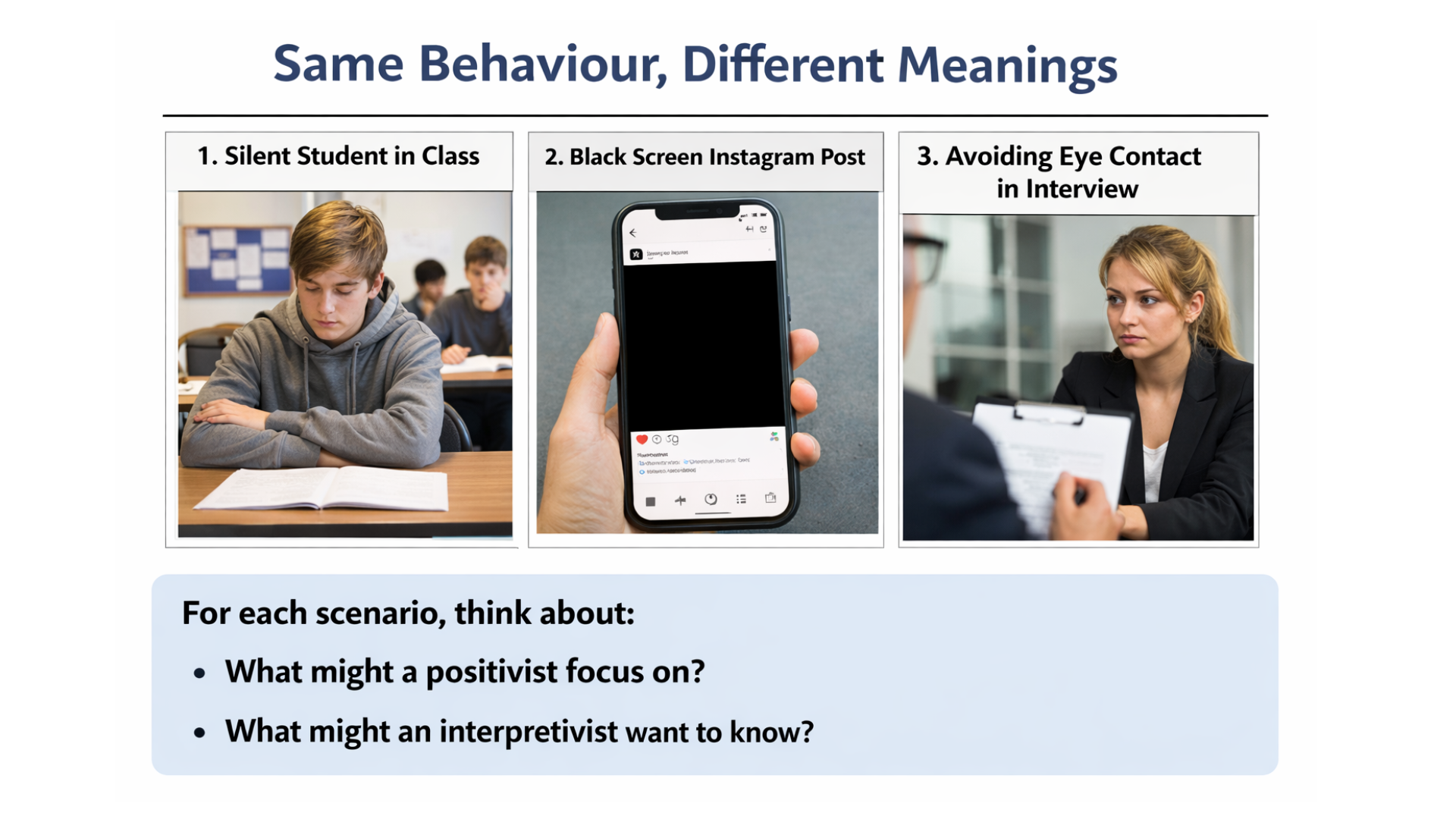
To begin, present three short scenarios on the board or a slide: a student sitting silently in class, a teenager posting a black screen on Instagram, and a person refusing to make eye contact in an interview. Ask students to work in pairs and discuss two guiding questions for each example: What might a positivist focus on? and What might an interpretivist want to know? These prompts encourage students to compare two sociological perspectives in a practical way rather than just memorising definitions.
Many students will quickly recognise that a positivist approach would focus on patterns and measurable trends. A positivist might ask how often this behaviour occurs, whether it happens more frequently in particular groups, or whether there is a wider statistical pattern. For example, they might investigate whether quiet students achieve higher grades, whether black-screen posts are linked to particular online trends, or whether avoiding eye contact correlates with interview outcomes. These questions reflect the positivist interest in objectivity, measurement and identifying patterns across large groups.
By contrast, interpretivists would approach the same behaviour from a different angle. Instead of starting with measurement, they would ask what the behaviour means to the person involved. Why is the student silent? Are they concentrating, feeling anxious, resisting participation, or simply tired? Why might someone post a black screen online? Is it a protest, a signal of distress, or part of a social media trend? Why might an interview candidate avoid eye contact? Are they nervous, culturally conditioned to show respect, or feeling uncomfortable in the situation? These questions highlight the interpretivist belief that social actions can only be fully understood by exploring the meanings people attach to them.
This activity is effective because it begins with everyday situations that students recognise. Rather than starting with abstract theory, it encourages them to think sociologically about familiar behaviour. The contrast between the two perspectives also becomes very clear: positivism focuses on measurement and patterns, while interpretivism focuses on meanings and understanding social action from the actor’s point of view.
For teachers who are new to sociology, this starter is particularly useful because it provides a natural bridge into key interpretivist concepts such as social action, meaning and Verstehen (empathetic understanding). It also prepares students for later discussions about research methods. Once students see that behaviour can have multiple meanings, it becomes easier to explain why interpretivists often prefer methods such as interviews or participant observation, which allow researchers to explore people’s experiences and perspectives in greater depth.
A PNG image, answer sheet and teacher question prompts are available below:
Leave a Reply