
At the start of each academic year I always ask my students how they revised for their exams. The most popular responses usually indicated a fatal flaw in allowing students to fulfil their potential:
- reading notes
- re-writing notes
- making flash cards
- making mind-maps by using notes
While these are all useful methods at one point in the revision process, ultimately they are all about students putting knowledge into their heads – not getting it out. I decided to offer my students revision worksheets to practise the key skills for each topic – knowledge recall, application of knowledge, analysis and evaluation and on this page I am sharing these with you. Below are worksheets for the modules I have taught and I will be loading up the answers to these on my youtube channel: https://www.youtube.com/channel/UCWU6adxjGXd9oKNkoaabD-w
Families and Households
Functionalism Families and Household
Marxism Families and Household – 2
Feminism Families and Household – 3
Post Modernity and Family Families and Household – 4
Modernity and the New Right Families and Households Modernity and the New
Gender Roles and Relationships – Domestic Labour Families and Household – Gender Roles and Relationships
Gender Roles and Relationships – Decision Making and Domestic Violence Families and Household – Gender Roles and Relationships 2
Social Construction of Childhood Social Construction of Childhood
Childhood is Disappearing Families and Household – Childhood 2
Demography – Birth Rates and Death Rates Families and Household – Demography, Birth Rates, Death Rates and Infant Mortality
Ageing Population and Migration Families and Household – Migration and Ageing Population
Research Methods
Experiments Experiments A3
Interviews Interviews A3
Observations Observations A3
Questionnaires Questionnaires a3
Sampling and Operationalising Variables Sampling Operationalising Variables A3
Secondary Sources and Historical Documents Secondary and Historical Documents
Methods in Context (MiC)
The MiC question is one of the hardest for students to get their heads around. Some tackle it as a straight forward methods question and talk about the strengths and limitations of the method, but that is only part of the question. Others, tend to talk about researching the issue in question, but again that will only get student so far.
The MiC question essentially asks students to think like a sociologist doing that research and so they need to consider not only HOW they are going to do the research, but also WHAT they are going to research and WHO they are going to research. Each of these requires a different set of skills. The HOW is dealt with above. Here I am going to put some materials on the WHO and WHAT
WHO are you researching?
Students should complete the following worksheets by listing some of the issues they may face when researching the group. An example of a completed sheet might look like this

Researching Teachers Teacher Features
Researching Students Student Samples
Researching Parents Parent Points


The WHAT
Students often forget that there is a subject matter being researched and this is why they often fail to get over 14/20. In my experience, keeping the topic you are studying in the forefront of your mind is key to getting into the top bands. With this in mind, students should practice thinking about the issues they are investigating. The very issues they have been studying throughout the education topic. Below are some blank templates for students to note down some of the issues with researching educational issues.
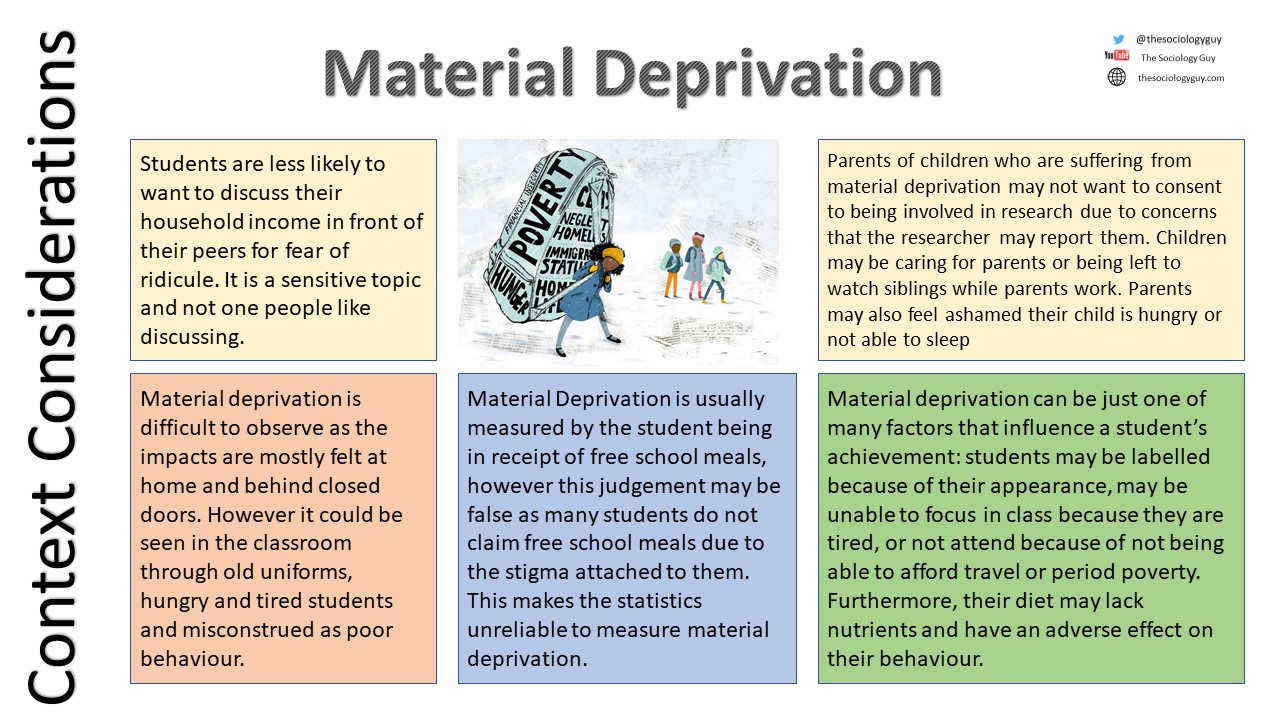
Context of Material Deprivation


Education
Theories of Education Revision Pack Theories of Education Revision Pack
Trends in Education Revision Pack Trends in Education Revision pack
5 REASONS WHY?
Quick check on students application and analysis skills. The following sheets are looking for 5 reasons why a trend in education has happened. 5 Concepts is more than enough for student to be able to answer most essay questions – especially as the questions often are not as straight-forward as those asked on these sheets.
EDUCATION

5 reasons for working class underachievement
5 reasons for differences in ethnic experience of education
CRIME AND DEVIANCE
5 reasons for working class crime
5 reasons – white collar crime

I will be adding more in the run up to the exams in May and June this year. Please follow me on twitter @thesociologyguy for more updates.