 by
by Understanding the Formation of Ethnic Minority Identities in Britain

The formation of ethnic minority identities in Britain is complex and influenced by history, society, and politics. Contemporary British sociologists have studied this extensively, helping us understand how these identities develop and change over time.
Historical Background
Britain’s colonial past has had a major impact on the ethnic makeup of the country. After World War II, people from former colonies such as the Caribbean and South Asia migrated to Britain. Many of these communities experienced discrimination and social exclusion, which shaped their collective identities.
Sociologists, such as Professor Roger Heath, have discussed the idea of ‘ethnic penalties’ – the disadvantages ethnic minorities, especially the children of immigrants, face in education, employment, and other areas of life (Heath, 2007).
How Identities Are Shaped
Ethnic identities are formed through socialisation. This means the way people learn about society and their place in it. Families pass on cultural values and traditions, peers can reinforce or challenge these, and schools and the media influence how individuals see themselves and how others see them.
Generational Differences
Identities often change across generations. Second-generation ethnic minorities (those born in the UK to immigrant parents) usually have a mix of cultural influences. They may combine elements of their family heritage with British culture, creating hybrid identities that reflect both continuity and change (Modood, 2019).
Intersectionality and Different Experiences
Not all ethnic minority experiences are the same. Factors such as gender, class, and religion intersect to shape identity. For example, Kalwant Bhopal’s research shows how South Asian women in Britain face unique challenges because of both their ethnicity and gender, particularly in education and social life (Bhopal, 2018).
Modern Challenges and Identity Politics
Today, many ethnic minority groups in Britain are more politically active, campaigning for rights and recognition. This has led to identity politics, where people assert their ethnic identities in public life. At the same time, debates continue around multiculturalism, integration, and British national identity, highlighting how ethnic identities are still being negotiated.
Theoretical Perspectives: Social Construction of Identity
Anderson (1983) introduced the concept of imagined communities, arguing that nations and ethnic groups are socially constructed. People feel a sense of belonging to a community through shared language, education, media, and national symbols. This perspective is useful for understanding ethnic identity in the UK because it highlights that identity is not innate, but shaped by social institutions and shared cultural practices. Ethnic identity, therefore, emerges from the interaction between individuals and the wider society, rather than being a natural or purely inherited trait.
Asian Identities in the UK
Research shows that Asian identities in Britain are often strongly linked to religion, family, and education.
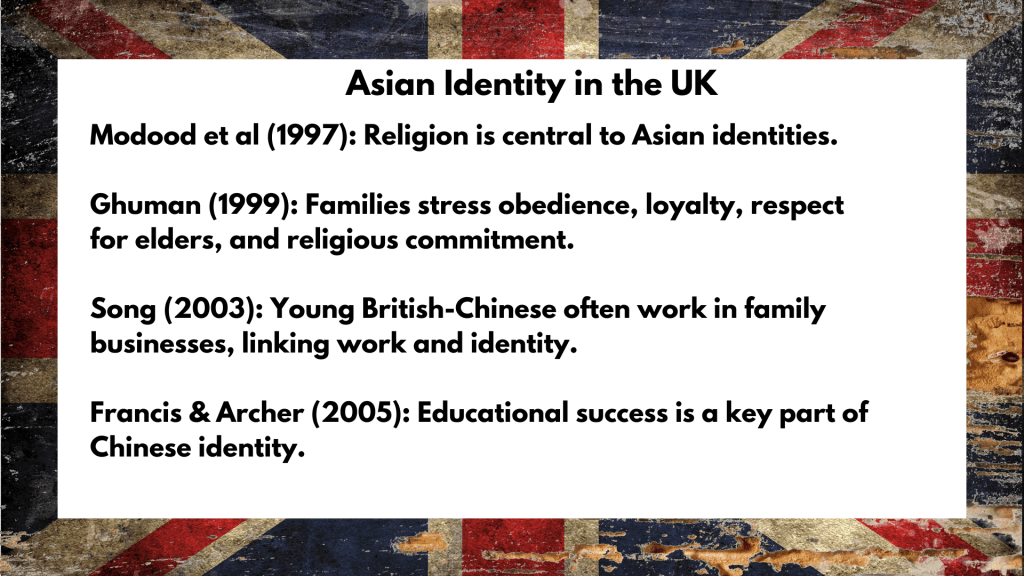
Modood et al (1997) conducted a study of ethnic minority groups and found that religion is central to the identities of many Asian communities. For example, Muslims and Sikhs often view religious practice as a key marker of belonging, which distinguishes them from the wider British population.
Ghuman (1999) studied British Asian families and found that parents emphasized obedience, duty, loyalty, respect for elders, and religious commitment. These cultural values are central to the transmission of ethnic identity across generations, highlighting the role of family in maintaining cultural continuity.
Song (2003) researched British-Chinese families and found that young people often participate in family-run businesses. This links work, family, and ethnic identity, showing that identity is not only cultural or religious but also connected to economic and social roles.
Francis and Archer (2005) focused specifically on British-Chinese students and found that academic achievement is a central feature of Chinese identity. Educational success is not just an individual goal but a cultural expectation that reinforces group identity.
Together, these studies show that Asian ethnic identities in the UK are multi-dimensional, combining religious practice, family loyalty, work roles, and education.
African-Caribbean Identities
African-Caribbean identity in the UK is shaped strongly by historical experiences and ongoing racism.
Gilroy (1993), in The Black Atlantic, argued that black identity is formed through shared experiences of slavery, colonialism, and racism rather than a single national origin. This perspective highlights that African-Caribbean identity transcends nationality and is linked to a broader diasporic experience.
Winston James (1993) found that racism and social exclusion in the UK led to the development of a shared black identity among African-Caribbean communities. This shared identity helped unite different Caribbean groups who might otherwise have distinct national or cultural backgrounds.
Modood et al (1997) also noted that racism and skin colour are central to African-Caribbean identities. Unlike some Asian groups where religion plays a key role, for African-Caribbean individuals, external social perceptions and experiences of discrimination significantly shape identity.
These studies illustrate that ethnic identity can emerge as a response to societal structures and racism, demonstrating the relational nature of identity formation – that is, identity is shaped in interaction with the wider society and in contrast to the experiences of others.
British-Pakistani and Muslim Identity
Jacobson (1997) studied young British-Pakistani Muslims and found that many developed a strong Islamic identity as a response to racism and Islamophobia. Religion becomes a source of both personal and collective identity, providing a sense of belonging and protection against social exclusion. This shows that ethnic identity can be reactive as well as cultural: in response to marginalization, individuals may emphasize religious and cultural distinctiveness as a means of coping with discrimination.
Travellers and Gypsy Communities
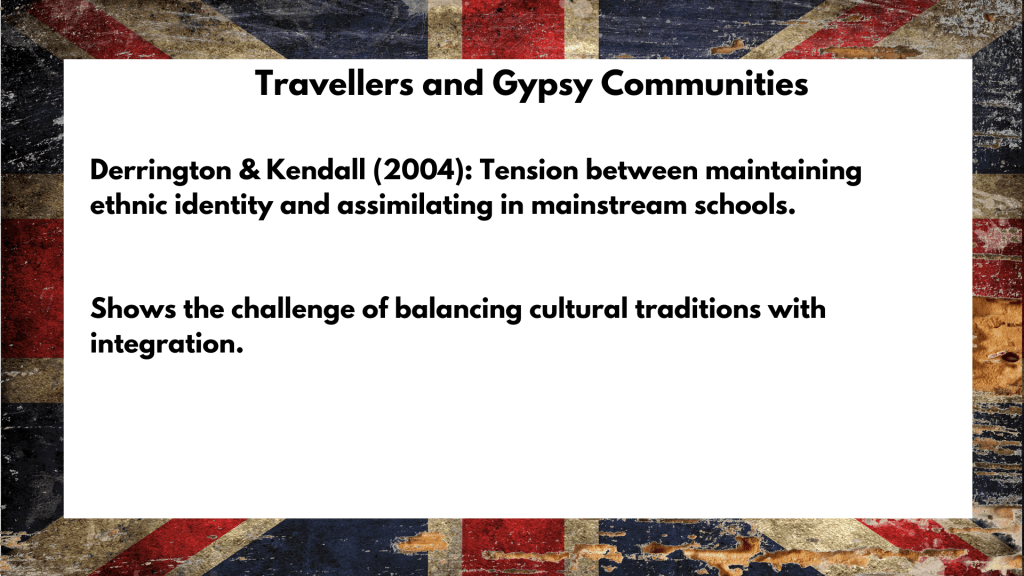
Derrington and Kendall (2004) researched Traveller and Gypsy children in UK schools. They found that these children often experience tension between maintaining their ethnic identity and conforming to mainstream school expectations. This highlights the challenges of negotiating ethnic identity in institutional settings. Young people may be pressured to assimilate, potentially leading to a conflict between cultural loyalty and social integration.
White Working-Class Identity
While much research focuses on minority groups, white British identity is also socially constructed.
Hewitt (1986) explored white working-class youth and found feelings of resentment towards the celebration of minority cultures, alongside a sense that their own “white” identity was ignored. This shows that majority groups can also feel marginalised in multicultural societies, highlighting that identity is relational and shaped in response to others.
Key Themes Across Research
- Religion and Family: For Asian communities, religion, family loyalty, and respect for elders are central to identity (Modood, Ghuman, Song).
- Education and Work: Educational success and work roles contribute to identity, especially in Chinese families (Francis & Archer, Song).
- Racism and Discrimination: For African-Caribbean and British-Pakistani groups, racism and Islamophobia play a central role in shaping identity (Gilroy, Winston James, Jacobson, Modood).
- Assimilation vs. Cultural Maintenance: Minority groups like Travellers face pressures to assimilate, creating tensions in identity formation (Derrington & Kendall).
- Majority Group Responses: White working-class youth may feel their own identity is overlooked, demonstrating that identity formation is not limited to minorities (Hewitt).
Conclusion
Ethnic identity in the UK is complex, socially constructed, and influenced by multiple factors. Sociologists have shown that identity is not fixed; it can be shaped by religion, family, education, racism, work, and wider social structures. It is often both personal and collective, reflecting individual experiences as well as broader historical and societal contexts.
In summary:
- Asian identities often emphasise religion, family values, and educational achievement.
- African-Caribbean identity is shaped by shared history and experiences of racism.
- British-Pakistani Muslims may develop strong religious identities in response to discrimination.
- Minority ethnic groups sometimes face tension between cultural maintenance and assimilation.
- White working-class identity can also be influenced by social marginalisation and perceptions of cultural neglect.
Understanding ethnic identity formation requires recognising both the internal, cultural dimensions of identity and the external, societal factors that shape how individuals and groups see themselves and are perceived by others. This makes the study of ethnic identity central to understanding social cohesion, multiculturalism, and inequality in contemporary Britain.
The formation of ethnic minority identities in Britain is ongoing and shaped by history, socialisation, generational change, and intersectional factors. Understanding these identities requires recognising the diversity of experiences within ethnic minority communities. Contemporary sociological research continues to give valuable insights into how these identities develop and evolve.
Key Sociologists to Remember:
- Anderson, B. (1983) Imagined Communities: Reflections on the Origin and Spread of Nationalism. London: Verso.
- Derrington, C. & Kendall, S. (2004) Gypsy Traveller Students in Secondary Schools: Culture, Identity and Achievement. Stoke-on-Trent: Trentham Books.
- Francis, B. & Archer, L. (2005) “British-Chinese Pupils’ and Parents’ Constructions of the Value of Education.” British Educational Research Journal, 31(1).
- Gilroy, P. (1993) The Black Atlantic: Modernity and Double Consciousness. London: Verso.
- Ghuman, P. (1999) Asian Adolescents in the West. Leicester: British Psychological Society.
- Hewitt, R. (1986) White Talk, Black Talk: Inter-Racial Friendship and Communication Amongst Adolescents. Cambridge: Cambridge University Press.
- Jacobson, J. (1997) Religion and Ethnicity: Dual and Alternative Sources of Identity Among Young British Pakistanis. Aldershot: Ashgate.
- James, W. (1993) Migration, Racism and Identity: The Caribbean Experience in Britain. London: Routledge.
- Modood, T. et al. (1997) Ethnic Minorities in Britain: Diversity and Disadvantage. London: Policy Studies Institute.
- Song, M. (2003) Choosing Ethnic Identity. Cambridge: Polity Press.
To download a PPT presentation that summarise this research/concepts and ideas, click the link below.






 The Sociology Guy
Leave a comment