 by
by When studying ethnic minority identities in sociology, we often ask: are traditional cultural identities still important, or are they being replaced by new, hybrid ones? The research below will help you think through both sides of this debate for a 20-mark essay for either OCR or AQA A level sociology. The question discussed here is taken directly from OCR Paper 1 (H580/01), but could equally appear on AQA A level Sociology on Paper 2 for the Culture and Identity option.
Evidence That Traditional Ethnic Identities Remain Important
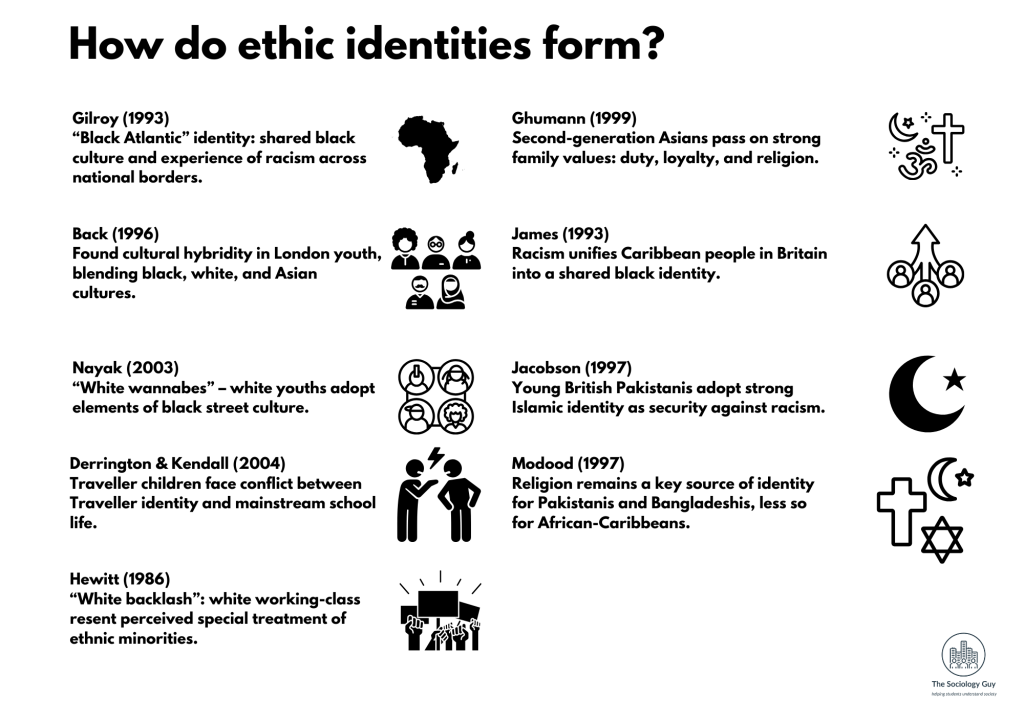
- Ghumann (1999) – Found second-generation Asians often inherit strong values of duty, loyalty, and respect from parents, closely tied to religion and culture.
- Jacobson (1997) – Showed that young British Pakistanis may adopt a strong Islamic identity as a positive source of belonging and resistance against racism.
- Modood (1997) – Found religion plays a central role in identity, especially for Pakistanis and Bangladeshis (though less so for African-Caribbeans).
- James (1993) – Argued the experience of racism unifies Caribbean people into a shared black identity, showing collective traditions and shared struggles remain powerful.
✅ These studies suggest that religion, family, and shared experiences of racism keep traditional identities alive and meaningful.
Evidence of Changing or Hybrid Identities
- Gilroy (1993) – The “Black Atlantic” shows a shared black culture that crosses national borders, blending traditional heritage with new global influences.
- Back (1996) – Found cultural hybridity in south London, with young people mixing black, white, and Asian cultures in creative ways.
- Nayak (2003) – Identified “white wannabes,” where white youths adopt aspects of black street culture, showing identities are no longer fixed to one ethnic group.
- Derrington & Kendall (2004) – Traveller children often face conflict between their traditional culture and mainstream school, highlighting tensions and adaptations.
- Hewitt (1986) – Found some white working-class people resent what they see as unfair advantages for ethnic minorities (“white backlash”), showing how changing multicultural identities can provoke resistance.
✅ These studies show that ethnic identities are not static; they are fluid, hybrid, and influenced by wider society.
Essay Planning: “Outline and briefly evaluate the view that traditional ethnic identities remain important” (20)
- AO1 (knowledge): Use Ghumann, Jacobson, Modood, James to show traditional values and religion still matter.
- AO2 (application): Apply to contemporary examples – e.g. Islamic identity after 9/11, Black Lives Matter uniting black communities.
- AO3 (evaluation):
- Counter with Gilroy, Back, Nayak → evidence of hybridity and change.
- Globalisation and media spread “pick and mix” identities.
- Generational differences – younger people may not see tradition as central.
Key Takeaway
Traditional ethnic identities are still significant, especially where religion and racism create unity. However, many young people live in multicultural contexts where hybrid identities are just as important. A balanced essay will argue that both traditional and new forms of identity shape ethnic minority experiences today.
Below are a completed summary and blank mindmap of these studies for you to use.
 The Sociology Guy
Leave a comment