 by
by One of the key debates in sociology is how far family life has changed over time and how diverse households are today. The media – whether TV shows, films, adverts, magazines, or social media – often shapes our ideas about what “typical” families look like. But are the families we see in the media representative of the range of family types that actually exist in society? Or do they reflect stereotypes and traditional norms?
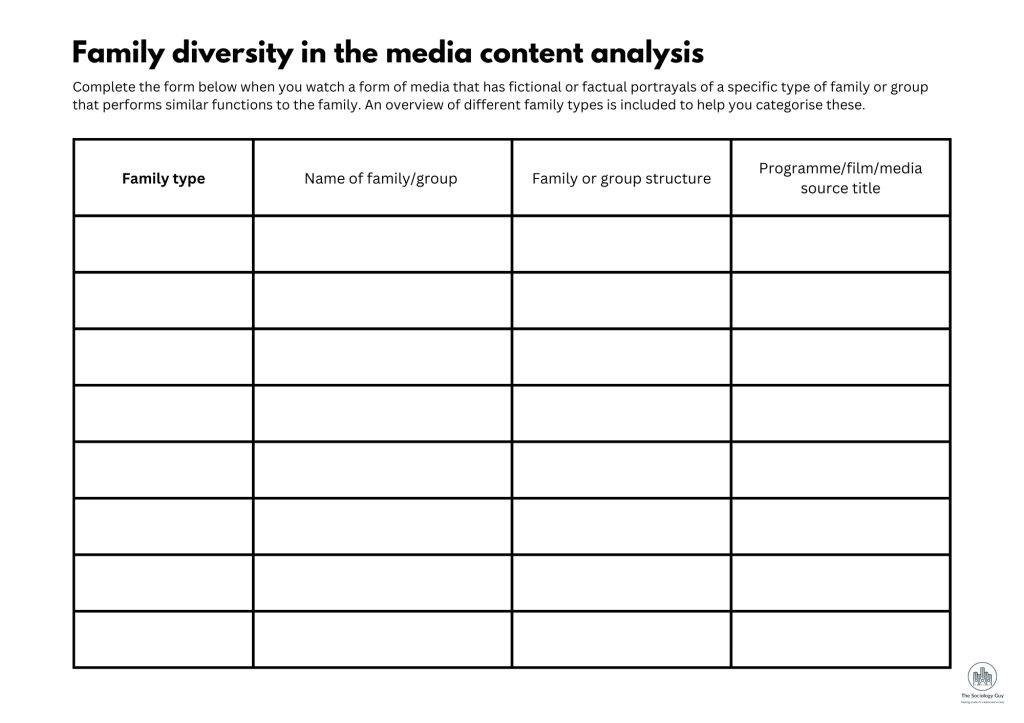
In this activity, you will explore how family diversity is represented across different forms of media. Working in groups or individually, you will collect examples of families shown in the media and then categorise them according to family type. You will then evaluate whether these representations reflect the true diversity of households in the UK.
What is Content Analysis?
To make sense of your findings, you will be using a sociological research method called content analysis. This is when researchers study media texts (such as TV, films, magazines, or social media posts) in a systematic way by categorising and counting the frequency of certain themes, images, or representations.
Content analysis is useful because it allows us to measure how often particular family types are shown, compare different media sources, and spot patterns or biases. For example, you might discover that nuclear families are much more common in TV adverts than same-sex families, which could suggest the media still favours traditional family images.
By applying content analysis to your collected examples, you’ll be able to judge whether the media reflects the true diversity of family life in the UK – or whether some groups remain underrepresented or stereotyped.
When collecting your examples, try to look for a wide range of representations. For instance, you might include:
- Nuclear families – e.g. The Simpsons or adverts showing the “mum, dad and two children” model.
- Single-parent families – e.g. Stacey and Mick in EastEnders, or real-life influencers who share their experiences of parenting alone.
- Reconstituted families (stepfamilies) – e.g. characters in Modern Family or The Kardashians.
- Same-sex parent families – e.g. Cam and Mitch in Modern Family, or UK adverts such as the Tesco Christmas campaign.
- Extended families – e.g. multigenerational households shown in programmes like Citizen Khan.
- Living alone/one-person households – common on social media influencers’ pages or lifestyle blogs.
- Cohabiting couples without children – seen in adverts for products aimed at young professionals.
As you collect your examples, think about:
- Which family types are shown most often?
- Which family types are rarely seen or ignored?
- Are families shown in a positive, negative, or stereotypical way?
This will help you evaluate whether the media reflects or distorts the reality of family diversity in contemporary Britain.
Use the material below with your students to help structure their content analysis of the different forms of family in the media.
 The Sociology Guy
Leave a comment