 by
by Allan and Crow are influential sociologists who studied family life in contemporary society, focusing particularly on family diversity. Their work is valuable for A-level students because it helps explain why traditional ideas of the nuclear family no longer capture the complexity of modern households.
Key Ideas
Allan and Crow argued that families are increasingly diverse, challenging the traditional nuclear family model of a married couple with dependent children. They identified that families now take many forms, including cohabiting couples, lone-parent families, same-sex couples, stepfamilies, and extended families. Their research highlights that family life cannot be understood through a single, dominant model, but rather through the variety of arrangements that people create in response to social, economic, and cultural pressures.
A key concept in their work is “negotiated families”. Allan and Crow suggest that modern families are less constrained by traditional roles and expectations. Instead, family members negotiate their responsibilities and relationships based on what works for them. For example, in dual-earner households, childcare and housework may be shared differently depending on the couple’s preferences and circumstances. This flexibility contrasts with the rigid gender roles often associated with the traditional nuclear family.
Allan and Crow also examined how social changes, such as women’s increased participation in the workforce, changing attitudes toward marriage, and rising divorce rates, have contributed to family diversity. They argued that these shifts mean that family life is now more individualized, with relationships being maintained based on choice rather than obligation.
Evaluations
While Allan and Crow’s work is influential, it has received some criticisms. One critique is that their concept of “negotiated families” may overemphasize choice and flexibility, underplaying the structural pressures that shape family life, such as poverty or cultural norms. For example, not all families have the resources to negotiate roles freely, and inequalities in gender and social class still influence family dynamics. Additionally, some critics argue that focusing on diversity may obscure the continuing prevalence of the nuclear family, particularly among certain social groups. Despite these criticisms, their work is praised for highlighting the complexity and fluidity of modern families, offering a more realistic view of contemporary household arrangements than earlier sociological models.
Application in AQA and OCR A-Level Exams
Allan and Crow’s ideas are particularly useful for students studying the optional topic of families and households. For AQA, students can use their work to explain trends in family diversity, including changes in family structure and the impact of social policies on family life. For example, an essay question might ask: “Explain reasons for changes in family patterns in the UK.” Here, students can draw on Allan and Crow to discuss cohabitation, negotiated roles, and the influence of social change.
For OCR, students can apply Allan and Crow’s ideas when exploring theories of family diversity. OCR questions often ask students to evaluate different perspectives on family life. Students could use Allan and Crow to support the view that families are becoming more diverse and individualized, contrasting with functionalist ideas that the nuclear family remains dominant. They can also integrate evaluations, such as feminist critiques that structural inequalities still affect family life, demonstrating analytical depth.
Students can also use Allan and Crow’s research in synoptic links, for example when comparing family diversity to household decision-making, gender roles, or the impact of social policies on families. Their work provides concrete examples of how families are negotiated and diversified, which helps students move beyond simple descriptions to critical analysis, a skill valued in both AQA and OCR exams.
Conclusion
Allan and Crow’s work on family diversity offers a nuanced understanding of contemporary households. By highlighting negotiated families and the role of social change in shaping family life, they provide students with a clear framework to explain and evaluate modern family structures. For A-level sociology, their ideas are a vital tool for exploring the optional topic of families and households, helping students link sociological theory to real-world examples and critically engage with debates on family diversity.
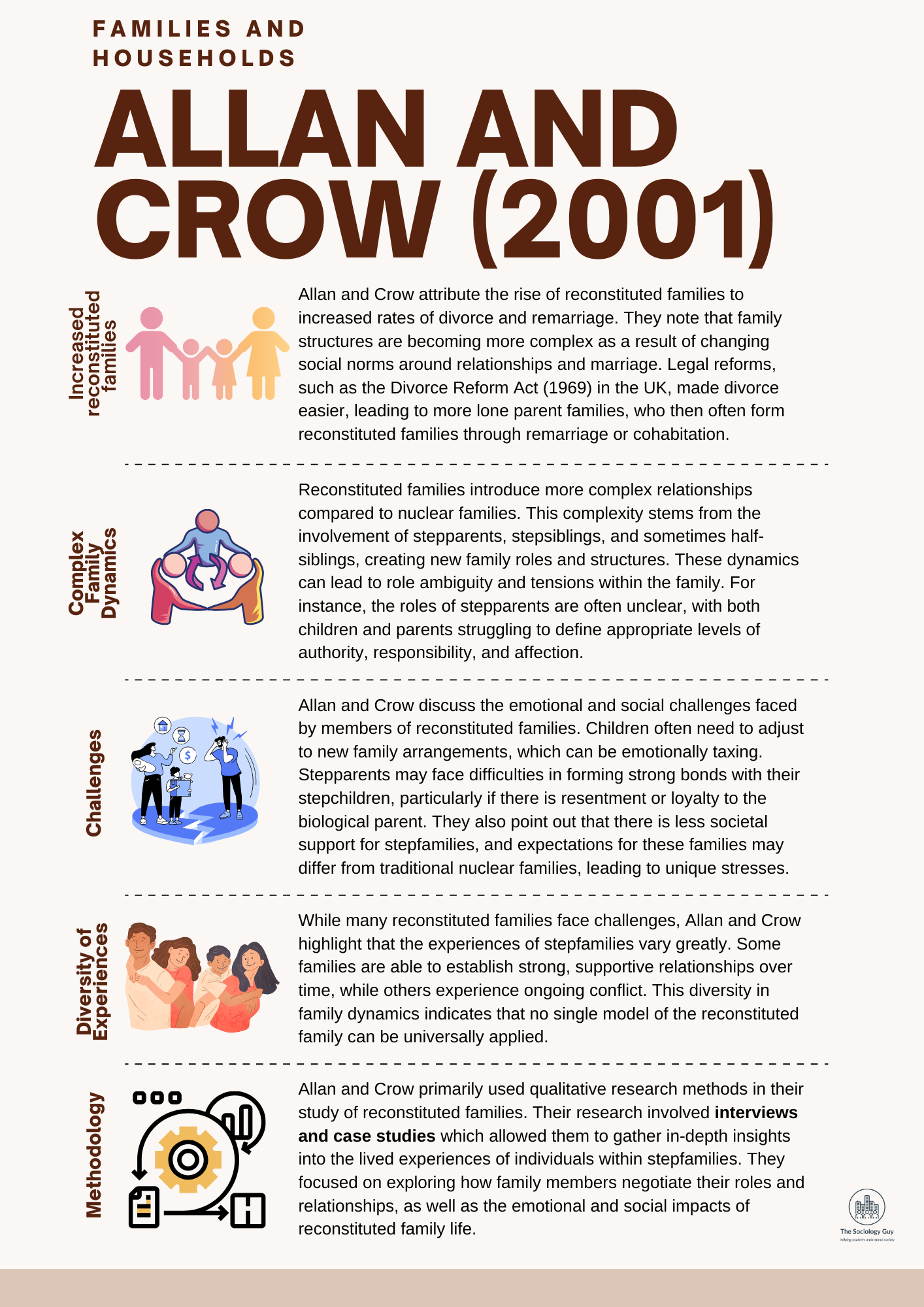
You can download a handout of their work below for your notes:
 The Sociology Guy
Leave a comment