 by
by A History of Youth Subcultures: From the 1950s to Today
Youth subcultures are more than just clothes, music, or slang. They represent identity, belonging, and sometimes resistance. By tracing them from the 1950s onwards, we can see how each generation has left its mark on culture and society.
1950s: Teddy Boys
The Teddy Boys, often known as “Teds,” were one of the first recognisable post-war youth subcultures in Britain. Inspired by Edwardian fashion, they wore long drape jackets, velvet collars, bootlace ties and crepe-soled shoes. For many working-class boys, this look was a way of claiming sophistication and style that was traditionally associated with the middle classes. The Teddy Boys also embraced the new rock ’n’ roll music imported from the United States, which shocked older generations who saw it as rebellious and immoral. While many Teds simply wanted to stand out, the subculture gained a reputation for violence and delinquency, particularly following clashes at cinemas and dance halls. Newspapers fuelled fears by presenting them as dangerous troublemakers, and this helped to spark the first real “moral panic” about youth in Britain. Yet, beneath the media stereotypes, the Teds were a sign that young people were beginning to carve out an independent cultural identity, separate from their parents’ generation. They showed that working-class youth were not passive consumers but active creators of style.

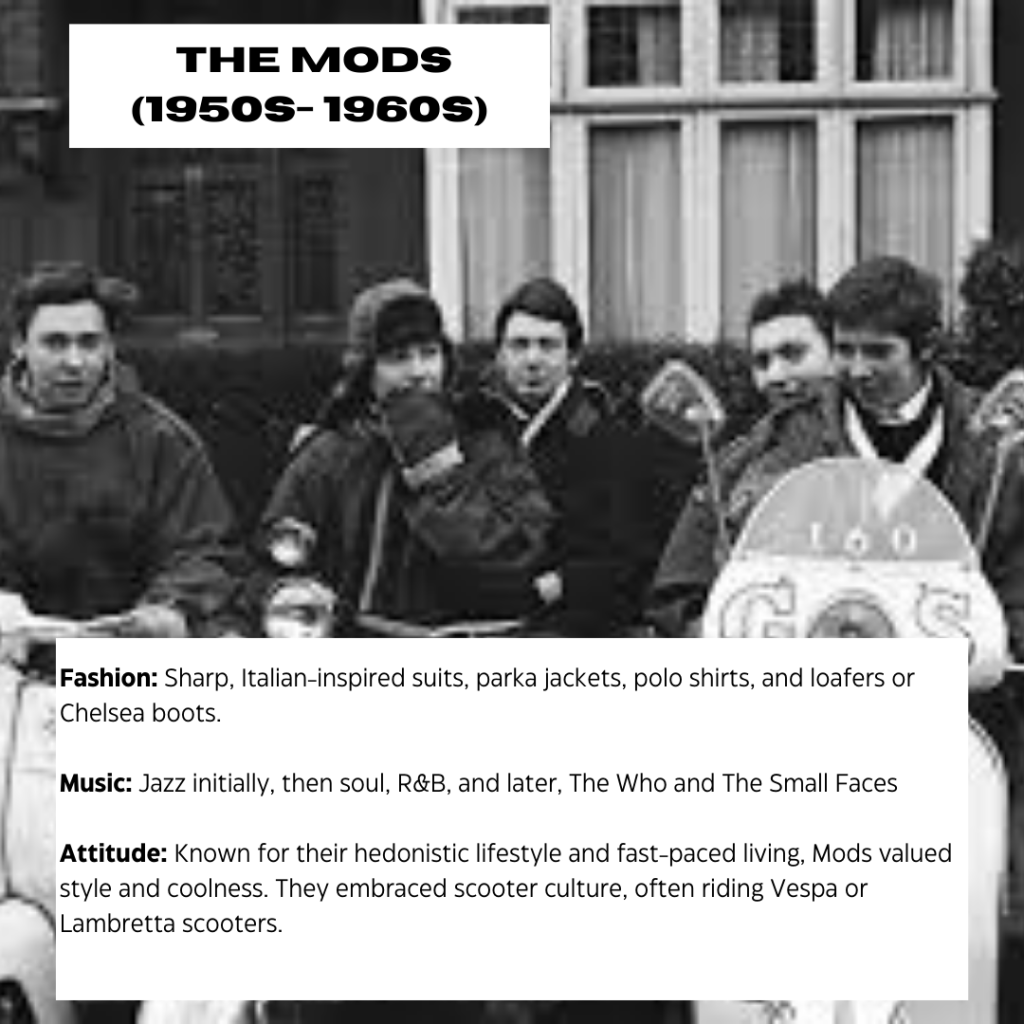

1960s: Mods and Rockers
The 1960s were defined by a cultural clash between two iconic groups: the Mods and the Rockers. Mods, short for “modernists,” were all about style, sophistication, and music. They wore sharp Italian suits, rode Lambretta or Vespa scooters, and listened to soul, jazz, and later The Who and The Small Faces. They prided themselves on being fashionable, urban, and cosmopolitan. By contrast, Rockers embraced a more rugged, rebellious image. Dressed in leather jackets, jeans, and riding motorbikes, they were inspired by 1950s American rock ’n’ roll icons like Elvis Presley and Marlon Brando. Rockers were associated with speed, danger, and toughness, projecting a working-class masculinity rooted in machinery and raw energy. The infamous seaside clashes between Mods and Rockers in places like Brighton in 1964 were sensationalised by the media, feeding into Stanley Cohen’s famous study of “folk devils and moral panics.” This confrontation represented more than just fights on the beach — it symbolised competing versions of youth identity. Mods were modern, stylish, and upwardly mobile, while Rockers celebrated toughness and tradition. Together, they marked the 1960s as a decade when youth culture became a powerful force shaping national identity.
1970s: Skinheads
Emerging from the working-class estates of late 1960s Britain, Skinheads were heavily influenced by Jamaican ska and reggae music brought over by Caribbean migrants. Their style was distinct: cropped hair, braces, Dr Martens boots, and rolled-up jeans. The look was practical and tough, reflecting their working-class roots, but also carried influences from West Indian culture. Early skinheads often celebrated multiculturalism, attending reggae clubs and embracing ska bands like The Specials. However, by the mid-1970s, parts of the movement shifted towards nationalism and were associated with far-right politics, creating divisions within the culture. The media often portrayed all Skinheads as violent racists, which overshadowed the subculture’s original multicultural influences. Skinheads became infamous for football hooliganism and street violence, cementing their place in the national imagination as threatening figures. Yet, sociologists have pointed out that Skinheads reflected the anxieties of a declining industrial economy and working-class identity under threat. The movement was both about pride and protest — pride in community, but also a protest against economic hardship and social change.


1970s–80s: Punks
The punk movement exploded onto the scene in the mid-1970s, offering one of the most radical challenges to mainstream culture. Inspired by bands like The Sex Pistols and The Clash, punks expressed anger at unemployment, poverty, and a sense of being abandoned by society. Their fashion was deliberately shocking: ripped clothes, safety pins, spiked hair, and chains. Many punks made their own outfits in a DIY style that rejected consumerism. Punk music was loud, fast, and aggressive, with lyrics that directly attacked the political establishment and the monarchy. The movement was heavily associated with anti-authoritarianism, chaos, and rebellion. Critics saw punks as degenerate, and newspapers portrayed them as a threat to social order, particularly following the notorious Sex Pistols’ TV appearance in 1976. However, punk was also about creativity and resistance. Fanzines, independent record labels, and grassroots gigs created a whole new form of cultural production that bypassed traditional institutions. Punk gave voice to working-class youth disillusioned with Britain in decline, and it continues to influence fashion, music, and activism today.
1980s: Goths
The Goth subculture emerged out of the ashes of punk, developing a darker, more introspective style. Associated with bands like Siouxsie and the Banshees, Bauhaus, and The Cure, Goth culture emphasised melancholy, theatrical fashion, and a fascination with the macabre. Black clothing, lace, eyeliner, and dyed hair were common, creating a distinctive look that stood out on the high street. Unlike punks, who confronted authority with aggression, Goths were more inward-looking, exploring themes of death, romance, and individualism through their style and music. Many young people found in Goth culture a safe space to express feelings of alienation and difference, particularly those who did not fit into mainstream ideals of masculinity or femininity. While often ridiculed in the press as “weird” or “morbid,” Goth culture was far from nihilistic. It provided a sense of community and belonging for young people who valued creativity, individuality, and acceptance. Unlike some earlier subcultures that were short-lived, Goth has remained a constant presence in youth culture, reinventing itself through different generations while maintaining its core aesthetic of dark romanticism.


1990s: Rave and Club Culture
The 1990s were dominated by rave culture, a scene built around electronic dance music, all-night parties, and a strong sense of collective energy. Young people flocked to warehouses, fields, and nightclubs, united by the hypnotic rhythms of house, techno, and trance. Fashion was colourful and practical — baggy jeans, sportswear, glow sticks, and smiley-face logos became iconic symbols of the scene. At the heart of rave culture was ecstasy (MDMA), a drug that intensified feelings of connection, euphoria, and belonging. The government responded with legislation such as the 1994 Criminal Justice and Public Order Act, which sought to clamp down on “gatherings where music with repetitive beats is played,” a clear attempt to suppress the movement. Despite this, rave culture became a powerful form of resistance against authority and mainstream norms. It celebrated inclusivity, diversity, and freedom, offering a utopian vision of community where class, race, and gender barriers seemed less significant. The commercialisation of dance music in the late 1990s led to a more mainstream “superclub” culture, but the underground spirit of raving has continued to inspire new generations, particularly in electronic music festivals around the world.
1990s: Britpop
Alongside rave culture, the mid-1990s also saw the rise of Britpop, a guitar-based movement that celebrated Britishness in the face of American dominance in the music charts. Bands like Oasis, Blur, Pulp, and Suede defined the sound of the era, offering catchy anthems that spoke to young people’s experiences of working-class life, relationships, and everyday struggles. Britpop was more than music — it was a lifestyle. Fans dressed in parkas, Adidas trainers, and Union Jack imagery, adopting a style that mixed casual fashion with pride in British identity. The rivalry between Oasis and Blur became a cultural phenomenon, symbolising a wider clash between working-class northern swagger and middle-class southern cool. For many young people, Britpop represented optimism and national pride, linking closely to the rise of “Cool Britannia” and the election of New Labour in 1997. However, critics argued that Britpop was apolitical compared to punk or rave, focusing more on nostalgia than resistance. Nevertheless, Britpop captured the spirit of the decade, giving young people a sense of cultural confidence and placing British youth culture firmly back in the global spotlight.


2000s: Emos
The early 2000s saw the rise of the Emo subculture, short for “emotional hardcore.” Emos were associated with bands such as My Chemical Romance, Fall Out Boy, and Paramore, whose lyrics dealt with themes of heartbreak, depression, and identity struggles. The style was distinctive: black skinny jeans, band T-shirts, studded belts, dark eyeliner, and often dyed or fringed hair. Unlike the aggressive rebellion of punks, Emos expressed resistance through vulnerability and introspection, making visible the emotional struggles of adolescence. Emo culture became a supportive community for many young people who felt alienated from mainstream norms, particularly those struggling with mental health, sexuality, or self-expression. However, it was also the target of ridicule and moral panic, with the media accusing Emos of glamorising self-harm and depression. Despite this negative attention, the subculture gave a voice to issues often silenced in youth culture, encouraging openness about feelings and mental health. In doing so, Emos challenged traditional ideas of masculinity and toughness, offering instead a model of sensitivity and emotional honesty.
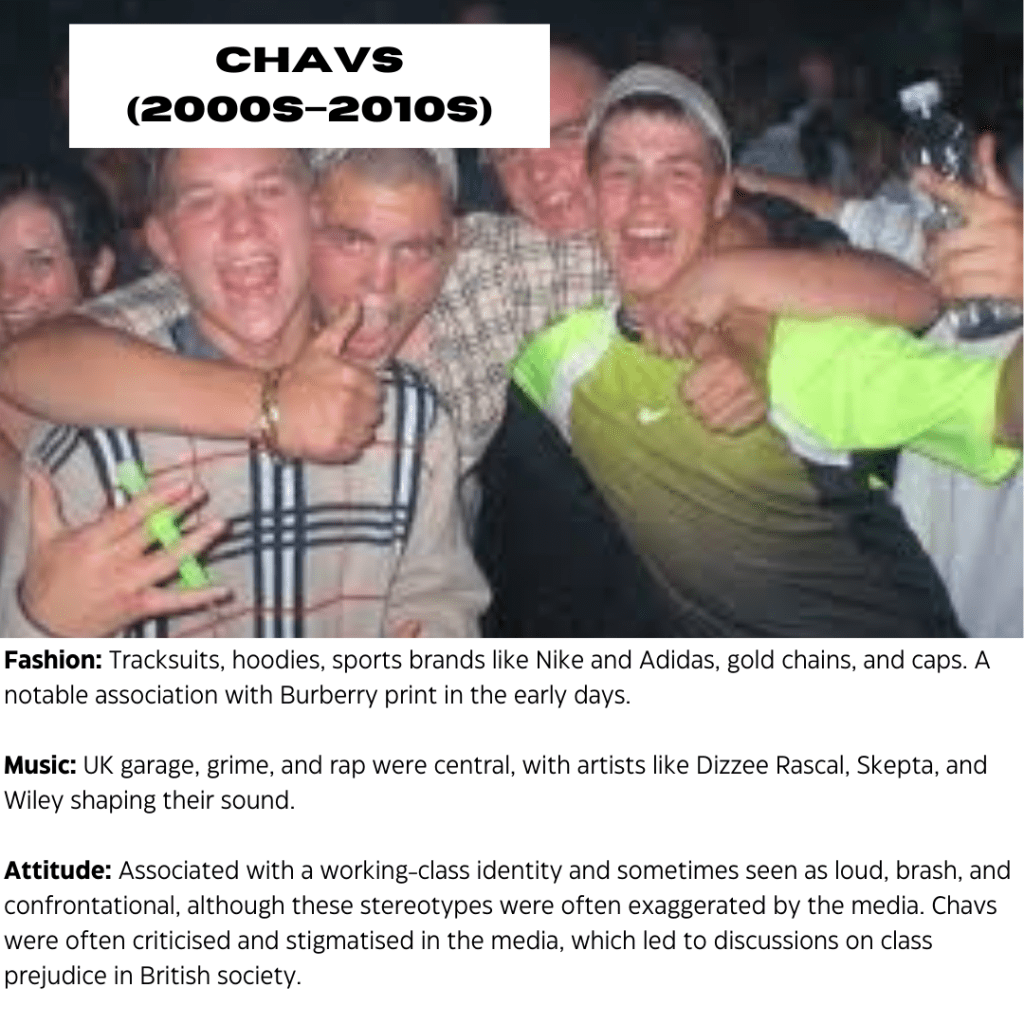
2000s: Chavs
During the same period, the term “chav” emerged in Britain, often used as a derogatory stereotype. Associated with working-class youth, the chav look was defined by sportswear brands like Burberry and Adidas, baseball caps, gold jewellery, and tracksuits. The chav figure became a staple of media satire and mockery, represented in TV shows and tabloid headlines as unruly, antisocial, and “common.” Unlike other subcultures, chav identity was often imposed from the outside, used as a way of stigmatising working-class communities rather than being embraced by young people themselves. Nevertheless, some youths did reclaim the label, wearing their style with pride and defiance. Sociologists argue that the demonisation of “chavs” reflected deeper class prejudices, as Britain in the 2000s became increasingly divided by wealth and opportunity. The chav stereotype allowed the middle classes to look down on the working class, portraying them as lazy, criminal, or culturally inferior. In this sense, the chav subculture — whether real or imagined — tells us less about young people themselves and more about how society polices class identity.
2010s: Hipsters
The 2010s brought the rise of the Hipster, a subculture defined by irony, nostalgia, and a taste for all things “alternative.” Hipsters rejected mainstream consumerism but embraced vintage fashion, retro technology, craft beer, and independent coffee shops. Their style often included skinny jeans, checked shirts, thick-rimmed glasses, and carefully groomed beards. Music tastes leaned towards indie and alternative bands, while cultural practices included cycling on vintage bikes and consuming artisanal products. The hipster identity reflected wider social changes, particularly the growth of gentrified urban areas where middle-class young people sought to create distinct identities through consumption. Critics mocked hipsters for being pretentious, privileged, and overly concerned with image, suggesting that their “rebellion” was superficial compared to earlier subcultures like punks or skinheads. Yet, hipsters also highlighted how youth culture in the digital age became closely tied to branding, identity, and lifestyle choices. They blurred the boundaries between subculture and mainstream, showing how quickly alternative styles can be absorbed into mass culture.
2010s: Grime and K-Pop Fans
Two very different but equally powerful youth cultures defined the 2010s: grime and K-pop fandoms. Grime, a UK-born genre rooted in East London, combined elements of garage, rap, and dancehall, with artists like Stormzy, Skepta, and Dizzee Rascal giving voice to urban working-class youth. Grime fans embraced streetwear fashion, tracksuits, and trainers, but more importantly, the culture expressed resistance to inequality, racism, and police surveillance. Grime represented authenticity, energy, and pride in local identity, becoming a political force when artists used their platform to encourage young people to vote. Meanwhile, K-pop fandoms grew globally, fuelled by social media. Fans of groups like BTS and Blackpink created online communities that were highly organised and passionate, producing fan art, streaming music, and even raising money for causes. Unlike traditional subcultures, K-pop fans were not tied to one country or class — instead, they showed how youth culture in the digital age can transcend borders and create global solidarity. Both grime and K-pop highlight how 2010s youth subcultures were shaped by globalisation, technology, and the power of online communities.


2020s: TikTok Tribes and Online Activism
In the 2020s, youth subcultures are increasingly shaped by online platforms, especially TikTok. Instead of fixed groups like punks or mods, young people now experiment with multiple micro-identities or “aesthetics.” These include cottagecore (romanticising rural life), goblincore (celebrating the messy and natural), and e-boy/e-girl culture, marked by bold makeup, dyed hair, and anime-inspired looks. Trends spread rapidly through TikTok videos, with fashion, slang, and humour going viral overnight. Unlike earlier subcultures that were rooted in local communities, TikTok tribes are global and fluid, changing with each new trend. Alongside this playful experimentation, youth culture in the 2020s has also been strongly political. Movements like Fridays for Future, Black Lives Matter, and online feminist activism show how young people use digital platforms to mobilise, protest, and demand change. Subculture today is no longer just about style or music — it is about online identity, creativity, and activism. While critics argue that TikTok culture is shallow or fleeting, it shows how young people continue to adapt subcultural traditions for the digital age, blending self-expression with social change.
 The Sociology Guy
Leave a comment