 by
by Introduction
The media shapes how we see the world — from news headlines and advertising to TikTok trends and online activism.
In A Level Sociology (OCR specification), students need to analyse and evaluate sociological perspectives on media ownership, control, and representation.
This post offers a clear, classroom-ready overview of the main perspectives, alongside a free downloadable resource pack that includes:
✅ A completed comparison grid for teachers
✅ A blank student version for independent or classroom research activities
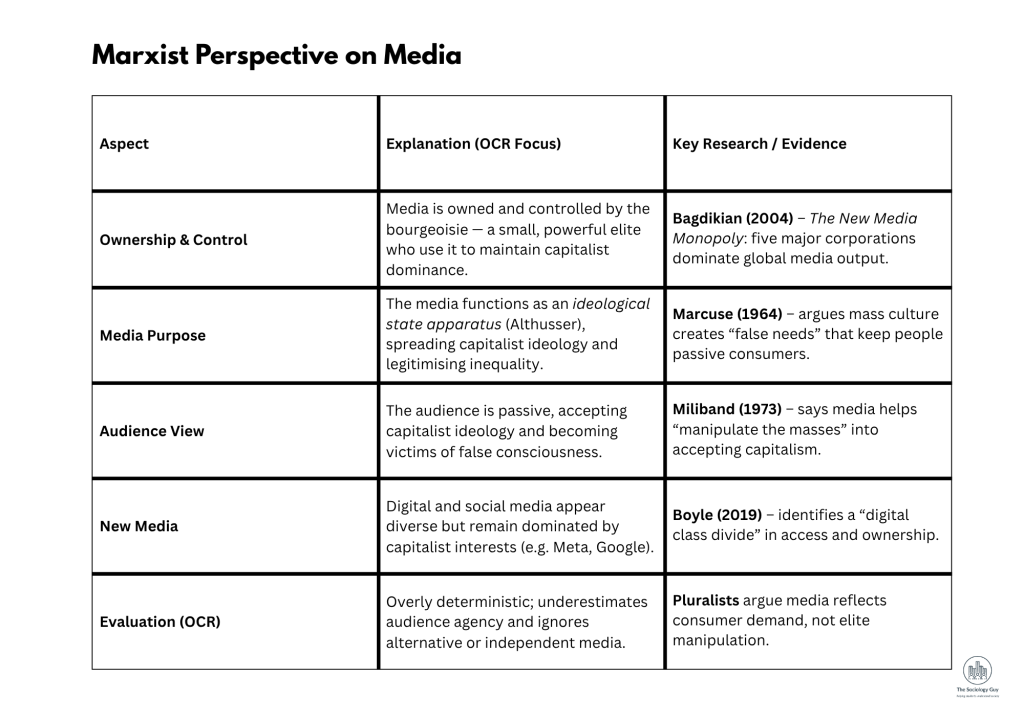
🔴 Marxist View: The Media as a Tool of Capitalist Control
Marxists argue that the media is owned and controlled by the ruling class, who use it to maintain capitalist power and promote consumerism.
The media acts as an ideological state apparatus (Althusser), spreading messages that justify inequality and discourage social change.
Key Researchers:
- Bagdikian (2004) – The New Media Monopoly shows how a handful of corporations dominate global media.
- Marcuse (1964) – argues that media promotes “false needs” through consumer culture.
🧠 OCR Focus: Explains how ownership reflects structural inequality and elite power.
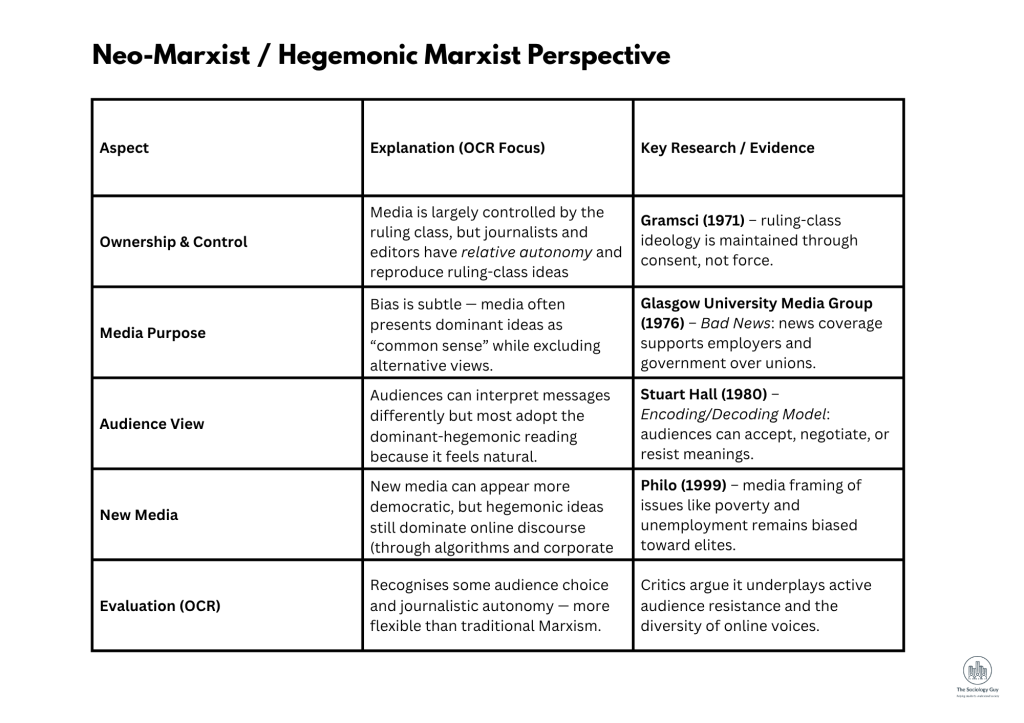
🔴 Neo-Marxist (Hegemonic Marxist) View: Subtle Ideological Influence
Neo-Marxists accept that journalists have some autonomy, but argue that media workers share middle-class values, leading them to reproduce ruling-class ideology unconsciously.
Media bias is presented as “neutral,” but often supports dominant groups.
Key Researchers:
- Stuart Hall (1980) – Encoding/Decoding Model shows how audiences interpret meanings differently.
- Glasgow University Media Group (1976) – Bad News found news reporting favoured employers over unions.
- Gramsci (1971) – described hegemony as the ruling class maintaining control through consent, not force.
🧠 OCR Focus: Useful for showing how ideology is maintained through subtle, consensual processes rather than direct manipulation.
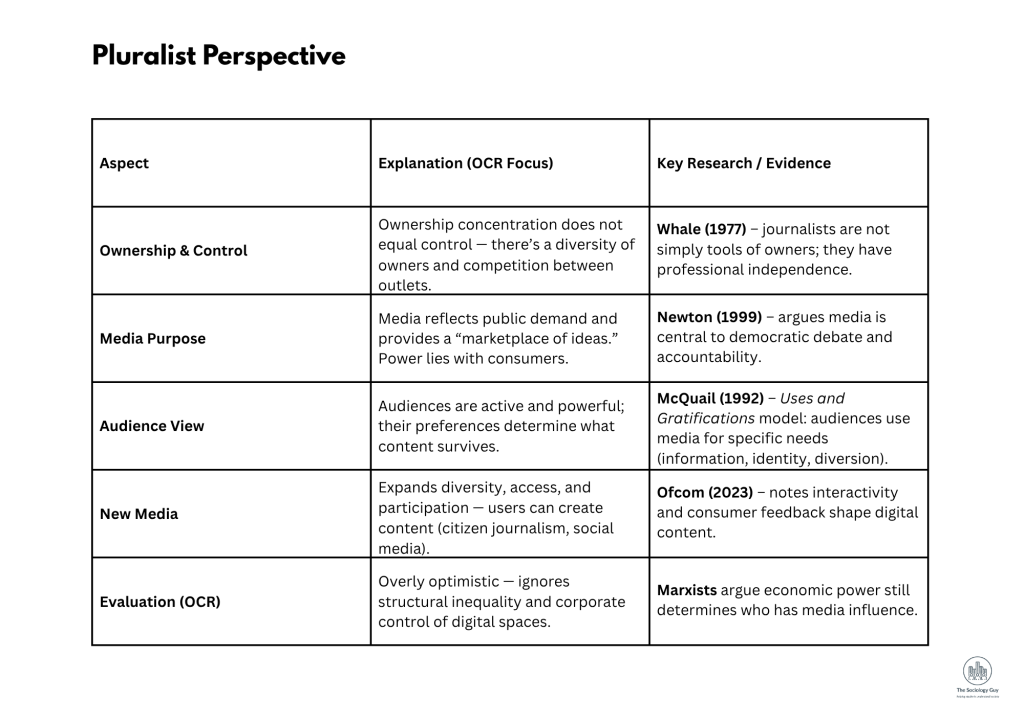
🔵 Pluralist View: Media Reflects Audience Demand
Pluralists argue that media ownership is diverse and competitive.
Rather than controlling audiences, the media responds to consumer demand — it gives people what they want.
In this view, audiences are powerful consumers shaping media content through their choices.
Key Researchers:
- Whale (1977) – journalists are not “puppets” of owners; they operate independently.
- McQuail (1992) – Uses and Gratifications Model: audiences use media to satisfy personal needs.
- Newton (1999) – sees the media as vital to democracy and debate.
🧠 OCR Focus: Contrasts sharply with Marxism — media power lies with audiences, not owners.
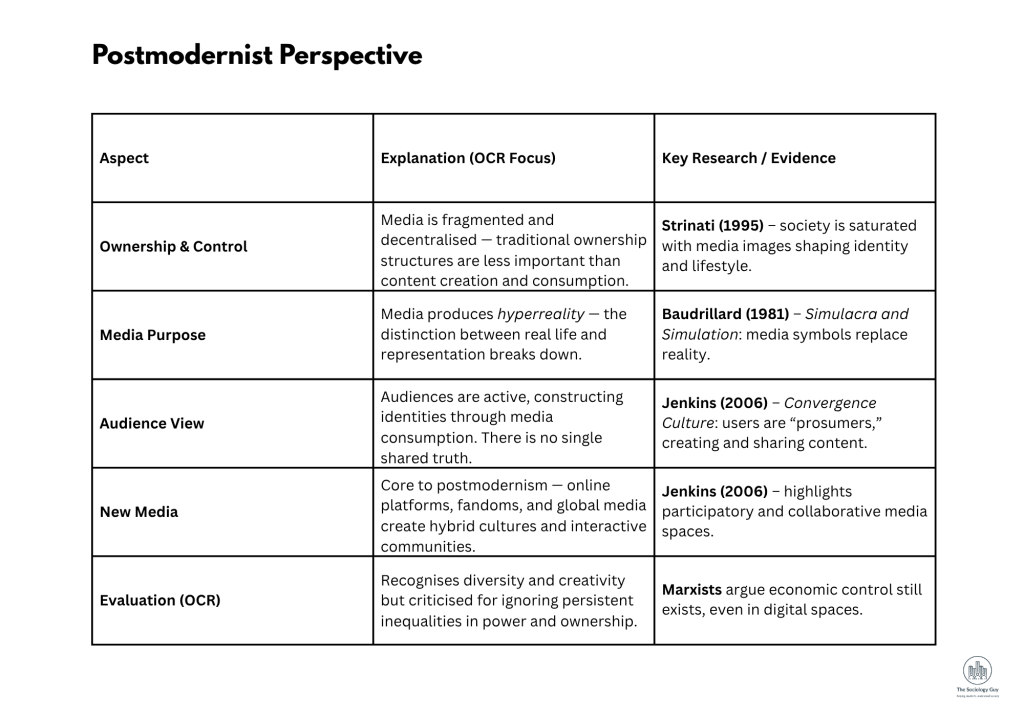
🟨 Postmodernist View: Media, Identity and Hyperreality
Postmodernists see today’s world as media-saturated, where the line between reality and representation is blurred.
Individuals use media to construct identities, remix culture, and engage with global digital spaces.
Key Researchers:
- Baudrillard (1981) – Simulacra and Simulation: the media no longer represents reality — it replaces it (hyperreality).
- Jenkins (2006) – Convergence Culture: describes participatory audiences who produce and share content.
- Strinati (1995) – argues that media and consumption dominate postmodern culture.
🧠 OCR Focus: Highlights audience creativity and the rise of digital participation — ideal for new media topics.
🟪 Feminist View: Media and Patriarchal Power
Feminists argue that the media remains male-dominated, reinforcing gender inequality through objectification, underrepresentation, and stereotypes.
However, new media also provides a space for feminist activism and voice.
Key Researchers:
- Mulvey (1975) – Male Gaze: women are portrayed as passive objects for male pleasure.
- Tuchman (1978) – Symbolic Annihilation: women’s achievements are trivialised or ignored.
- McRobbie (2009) – post-feminist media promotes contradictory messages about femininity.
- Gill (2008) – Gender and the Media: sexualisation continues even in modern, “empowered” representations.
🧠 OCR Focus: Essential for media representation of gender, linking to questions on patriarchy, ideology, and identity.
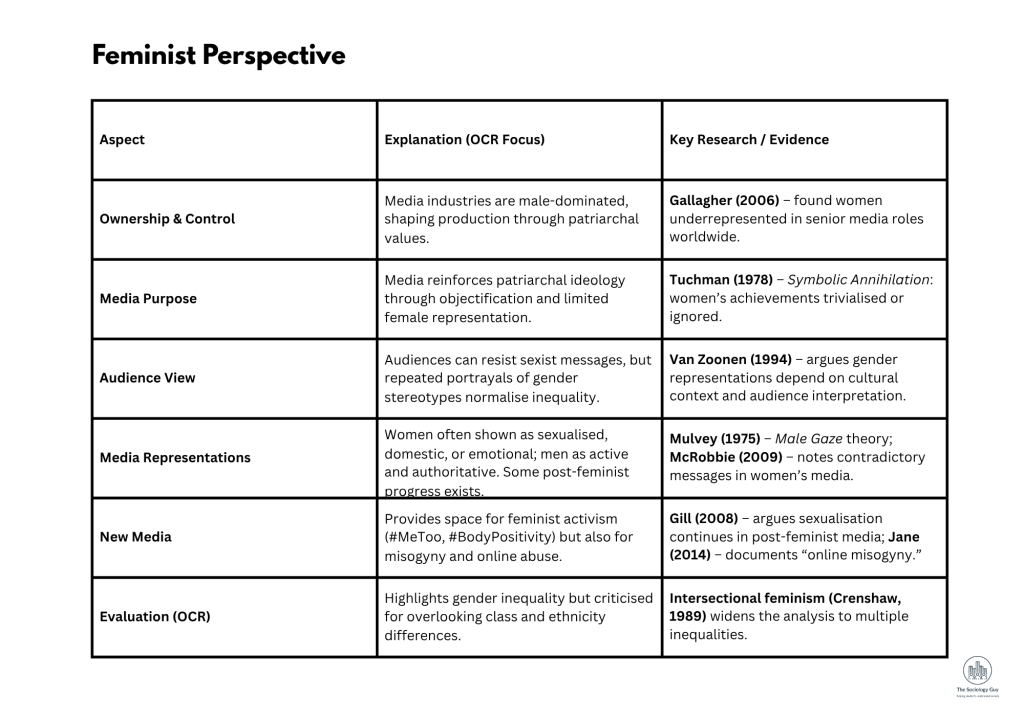
📚 Classroom Resource: Comparative Media Perspectives Pack
To support teachers and students, we’ve created a downloadable resource pack that includes:
- 🗂️ A completed comparison grid of all five perspectives (with key ideas and researchers)
- ✏️ Blank student versions for research notes, evaluation, and examples
- 🧩 Ideal for use in Cambridge OCR Paper 1 (Media) lessons, revision sessions, and essay planning
👉 Download the free Media Theory Pack below
Teaching Ideas
- Flipped learning: Assign each student a perspective to summarise with real-world media examples.
- Essay planning: Use the grid as a scaffold for extended questions on media ownership or representation.
- Active learning: Colour-code the grid (red = power/control theories; blue = audience agency theories).
Final Thought
Whether we see the media as a tool of capitalist control or a space for audience creativity, each theory offers a different lens on how information and images shape our lives.
By exploring these perspectives, students develop the critical thinking skills that lie at the heart of sociology; questioning who holds power and whose voices are heard
 The Sociology Guy
Leave a comment