 by
by Sociologists debate how powerful the media actually is. The key question is whether audiences are passive and shaped by the media, or active and able to interpret messages in their own way. The theories below show different ways of understanding how media influence works.
DIRECT MEDIA EFFECTS MODELS
These models assume the audience is more vulnerable to media influence. The effect is often seen as immediate.
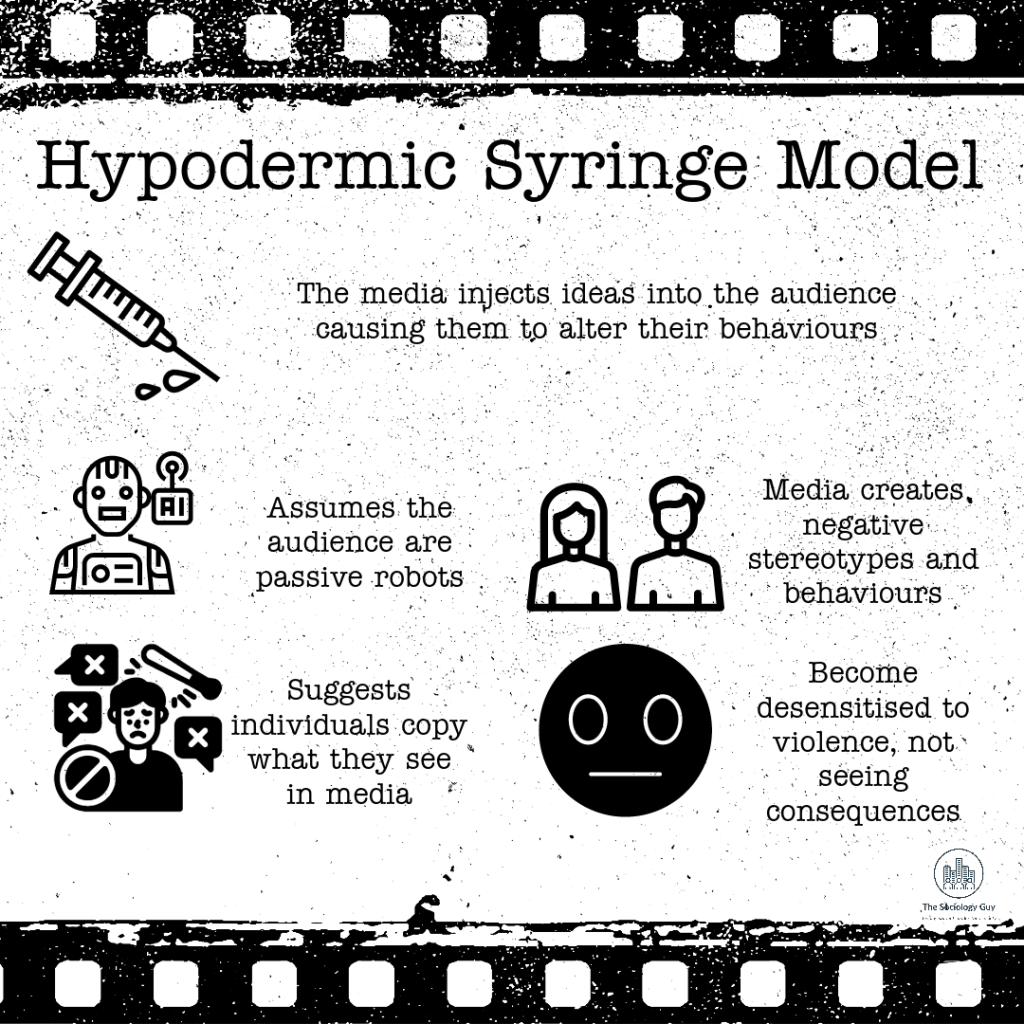
1. Hypodermic Syringe Model
Key idea: The media behaves like a syringe, injecting messages directly into the audience.
Audience role: Passive and easily influenced.
Linked to: The Frankfurt School, especially Adorno and Horkheimer.
They argued that mass media creates false needs, distracts the public from inequality and discourages critical thought. The model is often used in media panic debates.
Example:
When violent movies or games are blamed for youth crime. For example, after school shootings in the USA, politicians have sometimes blamed video games rather than considering wider social issues like access to guns or mental health. This demonstrates the simplistic way media effects are sometimes understood.
Strength: Highlights how powerful institutions may aim to influence people.
Weakness: Assumes everyone reacts the same way, which evidence does not support.
2. Social Learning Theory (Bandura)
Key idea: People learn through observation and imitation. Behaviour seen repeatedly becomes normalised.
Audience role: Not fully passive, but influenced by repeated exposure.
Research: The Bobo Doll experiment showed children imitated aggression after watching adults act aggressively.
Strength: Supported by psychological evidence.
Weakness: Assumes behaviour will always be imitated, which depends on personality and social environment.
Example:
Reality TV shows that normalise teasing, gossiping or competitive argument can shift ideas about what counts as acceptable social behaviour. Influencer culture can normalise cosmetic surgery, extreme dieting or materialistic lifestyle values.
INDIRECT MEDIA EFFECTS MODELS
These models argue media influence depends on social context, identity and interpretation.
3. Two-Step Flow Model (Katz and Lazarsfeld)
Key idea: Media influence flows first to opinion leaders, who then influence others.
Audience role: Active but shaped by personal relationships.
Opinion leaders might be teachers, celebrities, YouTubers or TikTok creators.
Example:
A news story might have little impact on some people until someone they follow on social media comments on it. The reaction of the influencer matters as much as the original information.
Strength: Fits modern social media behaviour well.
Weakness: Does not fully explain how opinion leaders themselves form their views.
4. Uses and Gratifications (Blumler and McPhail)

Key idea: Audiences choose media because it meets personal needs.
Audience role: Active and selective.
Needs include:
Information, identity, entertainment, social interaction, escapism.
Example:
A student scrolling TikTok to relax is using media for escapism. Someone watching political commentary videos for learning is using media for information. Media becomes a resource rather than a controlling force.
Strength: Recognises audience autonomy.
Weakness: Underplays how media content can still shape beliefs and normalise values.
5. Reception Analysis (Morley)
Key idea: Audiences interpret media differently based on social background.
Theorist: David Morley.
Audience role: Active meaning-makers.
Three viewer readings:
Dominant, negotiated, oppositional.
Example:
Coverage of strikes. Middle-class audiences might accept the dominant interpretation that strikes are disruptive. Working-class viewers may take an oppositional reading and see strikes as workers fighting for fair treatment.
Strength: Shows how class and culture shape interpretation.
Weakness: Can be hard to measure interpretations accurately.
6. Encoding/Decoding (Stuart Hall)
Key idea: Media producers encode meanings using shared cultural ideas. Audiences decode based on their own experiences.
This links strongly to power and ideology.
Example:
A music video celebrating luxury lifestyles encodes wealth as success. Some audiences will admire this, while others may see it as shallow or unattainable.
This model highlights how media is never neutral. It always contains values.
7. Cultural Effects Model (Glasgow University Media Group)
Key idea: Media influence works like a slow drip, shaping what seems normal or common sense.
Audience role: Gradually shaped rather than controlled.
Example:
Long-term news coverage portraying migrants as a strain on resources can shift public opinion even if no direct persuasion is attempted. This influence is subtle and accumulates over time.
Strength: Explains how ideology is reinforced across society.
Weakness: Hard to prove causation directly.
Exam Tip
A high-level answer will:
- Explain the model clearly.
- Give a real example.
- Evaluate the model by comparing it to at least one alternative approach.
For instance:
You could contrast the Hypodermic Syringe model with Reception Analysis to show how ideas about audiences have shifted from passive to active.
 The Sociology Guy
Leave a comment