In previous blog post I have discussed the advantage of a silent debate for both students and classroom management. It reduces the stakes for students, gives them more time to think deeply on the topic area and allows teachers to address potentially sensitive misconceptions. Furthermore, the smaller scale of a silent debate allows less vocal students to contribute, when they may fear speaking in front of their peers (for many different reasons).
Key to a silent debate is the ability to think before you speak. For many students this allows them to make mistakes in a safe environment and have supportive feedback, not only from teachers, but also from their peers (you only have to look at a whole area of Tik Tik that is dedicated to study support to realise that peers (sadly) will have more impact on a student’s self-esteem and self-efficacy than you as a teacher ever will.).
However, I digress. Below are the instruction for how to conduct a silent debate on Age and identity, drawing students own knowledge and sociological research together to create greater understanding of the issue.
Teacher Instructions: Silent Debate
Objective:
Students will critically explore and evaluate how identity develops and changes over time, considering influences such as family, peers, education, media, and wider society.
Preparation
- Materials Needed:
- Large sheets of paper or flipchart paper (one per group).
- Marker pens (different colours for each student if possible).
- Prompts or questions printed in the centre of each sheet.
- Example Prompts:
- Does identity change more because of personal choices or social structures?
- Which has the strongest influence on identity: family, peers, education, media, or work?
- Is identity fixed at any stage of life, or always fluid?
- How do factors like class, gender, ethnicity, or age affect changes in identity over time?
Running the Activity
- Set the Ground Rules:
- This is a silent activity — no talking, only writing.
- Students should read others’ comments and respond directly to them in writing.
- Encourage them to challenge, agree, question, or add examples.
- Round 1 – Initial Responses (5–7 minutes):
- Each group reads the question in the middle of their sheet.
- Students write their first thoughts, drawing on their sociological knowledge.
- Round 2 – Building Debate (10–12 minutes):
- Students move around the room, rotating between sheets (like a gallery walk).
- At each new sheet, they read what others have written and respond — by agreeing, challenging, or extending with theories, studies, or examples.
- Round 3 – Returning to Original Sheet (5 minutes):
- Groups return to their original sheet.
- They read how the debate has developed and add a final comment, summing up or evaluating the key ideas.
Debrief & Discussion (10–15 minutes)
- Bring the class together and discuss:
- What patterns or themes emerged across debates?
- Which sociological theories or evidence were most useful in explaining changes in identity?
- Did anyone’s views shift after reading others’ responses?
- Optionally, ask groups to present their sheet as a summary of “the debate” to the class.
Teacher Tips
- Encourage students to use sociological concepts (e.g., Mead on the self, Goffman on presentation of self, postmodern views on fluid identity).
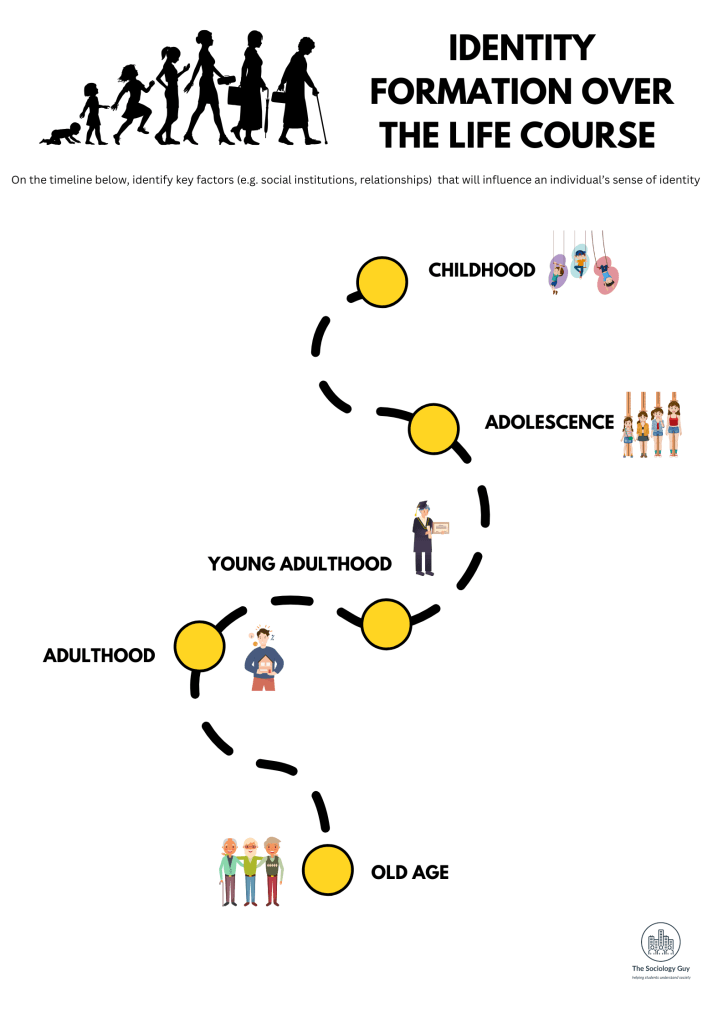
- Remind them to think about different life stages (childhood, adolescence, adulthood, later life).
- To stretch higher-level students: ask them to link ideas about identity to broader debates in sociology (e.g., structure vs agency, continuity vs change).
 The Sociology Guy