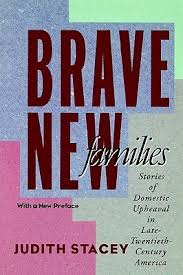
Judith Stacey is an American feminist sociologist whose book Brave New Families (1990) examined family diversity in postmodern societies. Although Stacey’s research was based in the US, her ideas have been widely applied in UK sociology because they capture the growth of diverse, fluid and negotiated family forms.
Unlike Marxist, radical or even Walby’s structural feminism, Stacey’s work emphasises choice, diversity and change rather than patriarchal structures. She argues families are no longer a single institution that consistently reproduces inequality — instead, we live in an era of “brave new families”, where gender roles, household structures and identities are plural and shifting.
2. Stacey’s core arguments (AO1)
(i) Postmodern diversity
- In late modern or postmodern societies, the family is no longer uniform.
- Women, in particular, are rejecting traditional gender roles and creating diverse family arrangements (single-parent households, blended families, cohabitation, same-sex partnerships, chosen families).
- This makes family life less predictable, but more open to negotiation.
(ii) Women as agents of change
- Stacey highlights that women are often the drivers of family diversity, leaving unhappy marriages or refusing to conform to traditional wife/mother roles.
- This reflects greater individual freedom and the breakdown of rigid patriarchal structures.
(iii) The decline of the traditional nuclear family
- The nuclear family no longer dominates; it is one family form among many.
- This does not mean families have disappeared, but that people experiment with new ways of living.
(iv) Family as negotiated
- Family life is fluid and shaped by individual choices.
- Roles are less fixed: men and women negotiate childcare, breadwinning, intimacy and household organisation.
- The result is pluralisation — there is no “normal family”, only families.
3. Research basis (AO1)
Stacey’s Brave New Families was based on in-depth life histories of families in Silicon Valley, California. She showed:
- Divorce, re-partnering and blended families were increasingly common.
- Women often led the reorganisation of family life.
- Families were dynamic — “postmodern families” adapted to changing circumstances.
Although US-based, these findings resonate strongly with UK family diversity (growth in lone-parent households, cohabitation, same-sex parenting, multicultural family forms).
4. Applying Stacey to UK family life (AO2)
Stacey’s ideas can be linked to UK evidence:
- Same-sex marriage (2014 UK law): reflects increasing family diversity.
- ONS data show rises in cohabitation, blended families and single-person households.
- Weeks’ “chosen families” research in the UK (among gay and lesbian communities) supports Stacey’s claim that people construct supportive family networks outside the traditional nuclear unit.
- The growth of dual-earner households in the UK also reflects negotiated gender roles, though uneven.
5. Evaluation of Stacey’s perspective (AO3)
Strengths:
- Recognises agency: women actively reshape family life, rather than being passive victims of patriarchy.
- Explains family diversity — useful for exam questions on family forms and postmodernity.
- Resonates with real social changes in the UK (decline of nuclear family dominance, growth of diverse households).
- Links well with Giddens’ and Beck’s theories of the “individualisation thesis”.
Weaknesses:
- Over-optimistic: assumes choice is available to all, but structural inequalities (class, race, poverty) still restrict options.
- Neglects continuity: nuclear families remain the most common form in the UK, even if less dominant.
- Underplays patriarchy: radical and socialist feminists argue inequality persists in new family forms (e.g. women still do more unpaid labour in blended or cohabiting households).
- Methodological limits: Stacey’s work was based on small-scale qualitative studies, limiting generalisability.
6. Comparing Stacey with other feminist perspectives
- Liberal feminism: Stacey goes further — she doesn’t just call for reform but sees structural change already happening through diversity.
- Marxist feminism: Stacey rejects the idea that all families serve capitalism — some resist or break away.
- Radical feminism: Stacey argues not all families are patriarchal; some new forms (e.g. same-sex households, chosen families) challenge male dominance.
- Intersectional feminism: Stacey is closer to intersectional approaches than earlier feminists, since she recognises diversity and fluidity, though she still doesn’t fully theorise race/class.
- Walby: Whereas Walby stresses enduring structures of patriarchy, Stacey highlights agency, choice and fragmentation — two contrasting ways to understand gender and family life.
7. Stacey in the exam (AO2/AO3 application)
Exam use:
- In “Evaluate feminist views of the family” questions, Stacey provides a postmodern challenge to structural feminist accounts.
- In “Examine changes in family diversity” questions, she offers a strong feminist contribution.
- Good for AO2 in linking US research to UK family trends (ONS data, Weeks, same-sex marriage).
Key phrasing for essays:
- “Stacey’s Brave New Families highlights the pluralisation of family life, with women often acting as agents of change, creating diverse and negotiated family forms.”
- “Unlike Walby, Stacey emphasises agency and choice over enduring structures of patriarchy.”
8. Conclusion
Judith Stacey’s Brave New Families is a landmark postmodern feminist text that challenges the idea of the family as a single, oppressive institution. By highlighting family diversity, women’s agency and negotiated roles, Stacey provides a more fluid and optimistic account of contemporary family life.
For A-level students, Stacey is exam-relevant in questions about family diversity, postmodernism, and feminist critiques. She complements (and contrasts with) structural approaches like Walby’s, offering a more individualised account of how families are changing in the late modern/postmodern UK.
You can download a teaching PowerPoint on Stacey’s seminal work from the link below:
 The Sociology Guy