The increasing visibility of same-sex families represents a major area of interest in contemporary sociology. Research into these families highlights changes in household structures, challenges traditional ideas of the nuclear family, and helps students explore family diversity, social change, and the influence of social policy. For A-level sociology, understanding these studies provides concrete examples and critical perspectives for both AQA and OCR exams.
Key Research Studies
- Weeks, Heaphy, and Donovan (2001)
Weeks and colleagues conducted qualitative research into same-sex households and found that these families often operate on principles of choice, negotiation, and equality. Their study highlighted how same-sex couples define family in ways that prioritize emotional bonds and shared responsibilities rather than traditional gender roles. For example, decisions about childcare and household tasks are negotiated between partners rather than being dictated by societal expectations. This research reinforces the idea of “negotiated families”, connecting closely to the work of Allan and Crow. - Golombok (2015)
Golombok’s work is crucial in understanding the impact of same-sex parenting on children. Her research, including longitudinal studies, indicates that children raised in same-sex families fare just as well in terms of emotional well-being, social adjustment, and academic performance as children in heterosexual households. This evidence challenges assumptions that only heterosexual families provide “proper” child-rearing environments, supporting the argument that family diversity does not harm children. - Dunne (1999)
Dunne conducted interviews with lesbian couples in Britain and found that co-parenting arrangements were highly egalitarian. Lesbian couples often shared domestic and childcare responsibilities equally, in contrast to the more traditional gendered roles observed in many heterosexual households. This research demonstrates how sexual orientation can influence household roles, further highlighting diversity within modern families. - Tasker and Golombok (1995)
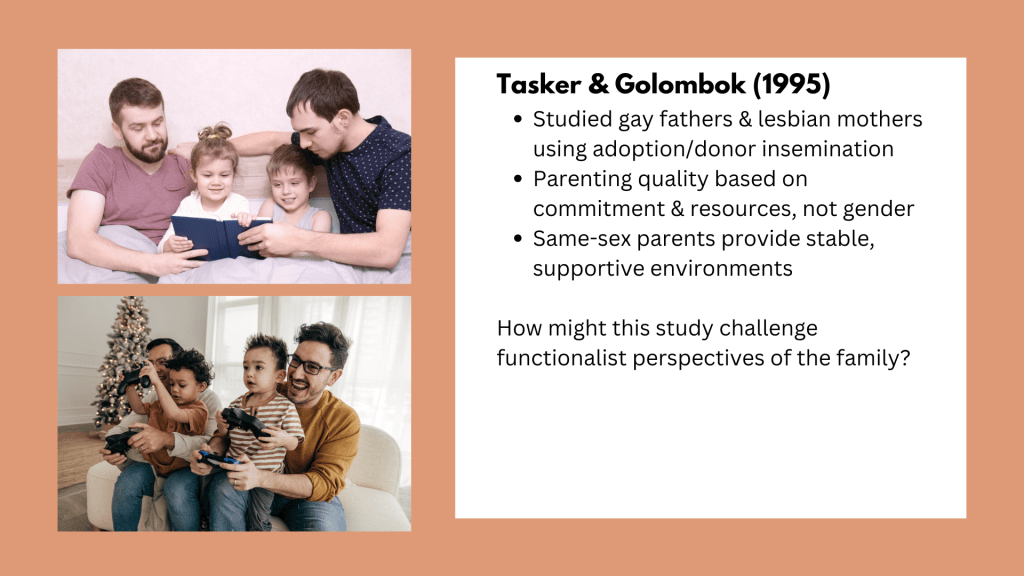
Tasker and Golombok investigated gay fathers and lesbian mothers who used adoption or donor insemination. Their research confirmed that same-sex parents are capable of providing stable and supportive family environments, emphasizing that parenting quality is determined by commitment and resources rather than gender composition. These findings are useful for evaluating theories of family diversity and challenging the traditional functionalist focus on the nuclear family. - Legal and Policy Research
Research into the impact of civil partnerships and same-sex marriage in the UK shows that legal recognition improves stability and security for same-sex families. Studies suggest that the legal acknowledgment of relationships reduces stress and strengthens family bonds, demonstrating the role of social policy in shaping modern family life.
Evaluations
While these studies provide strong evidence of the viability and diversity of same-sex families, there are limitations. Many studies focus on middle-class, urban households, which may not represent all socio-economic or ethnic groups. Sample sizes are often small, limiting generalizability. Critics, particularly from the New Right, continue to argue that children need both male and female parents, though empirical research generally contradicts this claim. Nevertheless, this body of research is widely valued for challenging traditional norms and expanding the understanding of family diversity.
Application in AQA and OCR A-Level Exams
For AQA, research into same-sex families can be used to explain trends in family diversity. An essay such as “Explain changes in family patterns in the UK” can draw on studies by Weeks, Dunne, Golombok, and Tasker to illustrate diverse family forms and the role of choice in household arrangements. Students can also link legal changes, such as civil partnerships and same-sex marriage, to social change.
For OCR, research supports discussions of theories of family diversity, allowing students to evaluate different perspectives. Students can contrast functionalist claims that the nuclear family is dominant with evidence from same-sex families demonstrating flexibility, egalitarianism, and positive child outcomes. Evaluations might include feminist perspectives on inequality, or critiques of research limitations, demonstrating critical analysis.
Students can also use this research in synoptic links, for example when discussing gender roles, childcare, social policy, or childhood outcomes. Using concrete studies helps students move beyond description to analysis and evaluation, skills essential for both AQA and OCR exams.
Conclusion
Sociological research into same-sex families provides detailed evidence of family diversity, negotiation, and equality in modern households. By examining studies on parenting, cohabitation, and legal recognition, students gain a nuanced understanding of contemporary family life. For A-level sociology, this research equips students with concrete examples and evaluative points for exploring the optional topic of families and households, supporting both essay and evaluation-based questions.




 The Sociology Guy