Section B: Understanding Social Inequalities is one of the most relevant and engaging parts of your course: in it you explore how inequality shapes people’s lives in contemporary society, and how sociologists explain these patterns.
1. What Are the Main Patterns and Trends in Social Inequality?
Inequality affects different groups in different ways. In this unit you’ll look at how social class, gender, ethnicity, and age influence people’s experiences in work, income, health, and other areas of social life.
- Social class: We’ll examine how wealth, income and occupational status remain distributed unequally, how class still matters despite claims of a “classless society”, and how life chances differ accordingly.
- Gender: You’ll consider how men and women’s life chances differ — in pay, employment, domestic work, representation, and how these patterns change (or don’t) over time.
- Ethnicity: You’ll study how different ethnic groups experience society — from education and employment to criminal justice and health — and how inequalities persist.
- Age: We’ll look at how inequality changes over the life-course — for example youth unemployment, the working age population, older age poverty and generational differences.
In each case you’ll look at patterns and trends:
- Who has access to opportunities — in work, housing, education?
- How do the experiences of different groups compare?
- How do inequalities affect life chances — the opportunities someone has to change their social position, achieve well-being, etc?
- What evidence is there (for example in pay, employment, health outcomes, regional divides)?
Recent Trends to Note
Here are some current data points to bring the topic right up to date:
- In the UK, the inequality of disposable income (after taxes & benefits) showed a slight decrease in 2024 — the Gini coefficient for disposable income was 32.9% in the year ending 2024, a slight drop from 33.1% the year before. Office for National Statistics
- However, original income inequality (before taxes & benefits) remains high and only slowly decreasing over the longer term. Office for National Statistics
- In terms of class and wealth, one report found that the richest 20% have much higher incomes than the poorest 20%: for example in 2022 the poorest 20% had on average about £13,218, while the richest 20% had about £83,687. Equality Trust
- In health, the gap between life expectancy for people in the least deprived vs most deprived areas remains large (for women in England: 8.4 years difference; for men: 10.4 years difference, for recent years). The King’s Fund
- In education and social mobility: recent data show that disadvantaged pupils are still much less likely to progress to university compared with peers from more advantaged backgrounds — eg in England 29% of students who had free school meals progressed to university by age 19 compared with 50% of their peers. Financial Times
These trends show that although there might be slight shifts, many inequalities remain persistent and deep-rooted.
2. How Can Patterns and Trends in Social Inequality and Difference Be Explained?
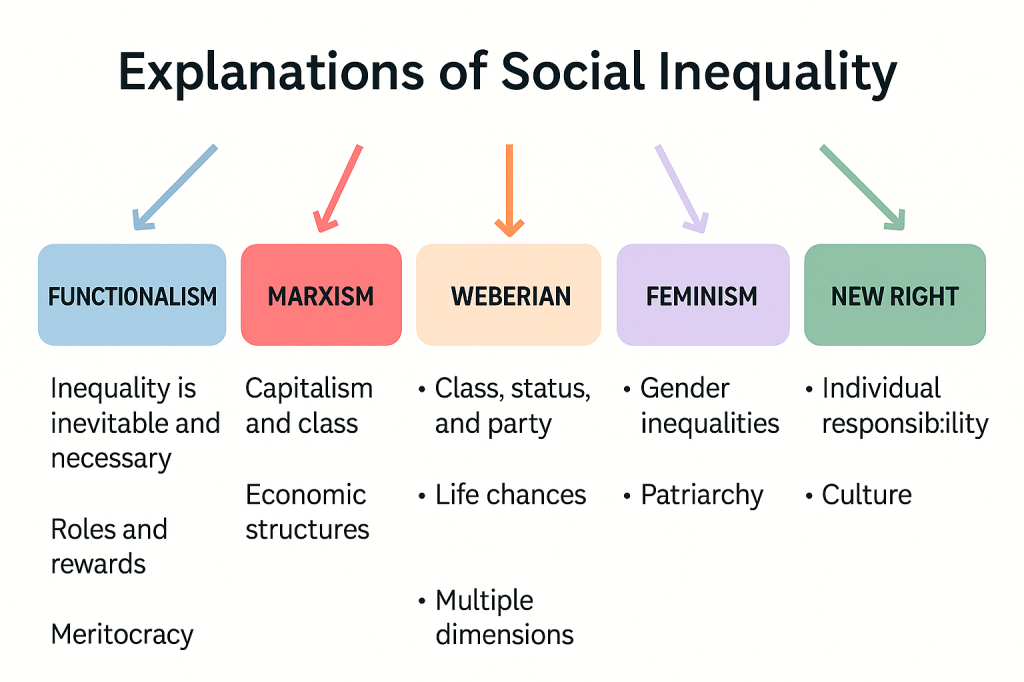
Understanding what causes or maintains inequality is a major part of the sociological task. We’ll work through the main explanations:
- Functionalism: This theory argues that inequality is inevitable, even necessary — society needs differences in reward to ensure people do the right jobs, and that those who are most capable rise to the top.
- Marxism: Focuses on class and the capitalist system — the control of the means of production, exploitation of labour, the idea of ruling and working class. Inequality arises from economic structures and power relations.
- Weberian: Adds nuance to class theory by recognising three dimensions of inequality: class (economic), status (social prestige) and party (power). Weberians argue that people’s life chances are affected by these multiple dimensions.
- Feminism: Focuses on gender as a central axis of inequality. Different strands (liberal feminism, Marxist feminism, radical feminism, intersectional feminism) explain how patriarchy, gendered divisions of labour, and intersecting identities (gender + class + ethnicity) shape inequality.
- New Right: Often argues that individual responsibility, culture and personal choice play strong roles in determining life-chances; they emphasise the role of the market, family structure, and see state intervention as potentially reducing incentive.
You’ll need to understand the key concepts in each theory, how they apply to your topic areas (class, gender, ethnicity, age), and evaluate their strengths and limitations (for example, how well they explain current trends, or how they might miss intersectionality or agency).
3. Linking the Two: Patterns + Explanations
Putting the two parts together is key:
- When you look at a pattern — such as women being paid less than men, or ethnic minority groups having lower average incomes, or a region having lower life expectancy — ask: Which theories help explain this, and why?
- For example: Why might health inequalities persist across regions? A Marxist might point to economic deprivation and exploitation; a Weberian might emphasise status and power differences; a New Right explanation might focus on individual lifestyle choices; a feminist (or intersectional) perspective might draw attention to how gender, ethnicity and class combine.
- You’ll need to use evidence (statistics, studies) to support your points, and evaluate – what doesn’t each explanation cover? Can the theories be combined? Are they outdated for today’s context?
4. Exam and Study Tips for You
- Be clear on definitions: terms like “life chances”, “inequality”, “difference”, “structural vs. individual explanation”.
- Use current and relevant evidence: recent statistics help show you understand how inequality works now — include trends like the ones above.
- Link theory to evidence: Don’t treat theory in isolation — always show how the theory applies to the pattern you’re discussing.
- Evaluate: For each explanation you present, reflect on what it does well and where it might fall short. Ask: does it consider intersectionality (class and gender and ethnicity)? Does it apply to age? Does it address global or local contexts?
- Structure your essays well: Introduction (define key terms), body (pattern + evidence + explanation), evaluation, conclusion (overall judgement).
- Stay up to date: Keep an eye on current reports, news, data sets — the exam markers like to see awareness of changing trends.
 The Sociology Guy