 by
by Background: The “Raising the Flag” Movement
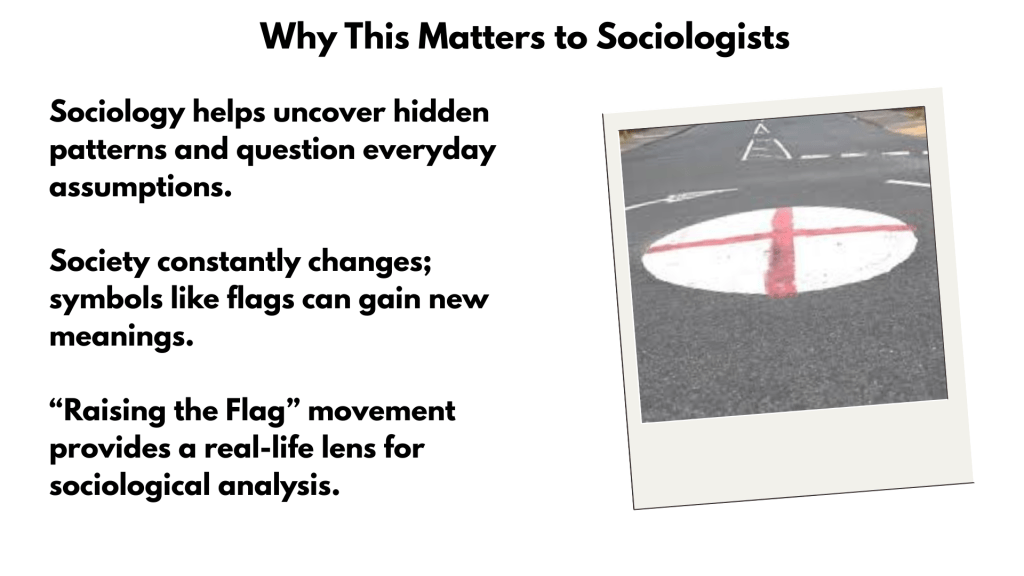
In July 2025, a grassroots initiative called “Operation Raise the Colours” began in Birmingham, following a controversy over a schoolgirl expressing pride in her British identity through a Union Jack-themed outfit. The campaign quickly spread across England, with thousands of Union Jacks and St George’s Crosses appearing on lampposts, roundabouts, and street corners.
The movement involves grassroots groups such as the Weoley Warriors and Flag Force UK, alongside individuals with alleged links to far-right movements. While supporters argue the movement expresses patriotism and unity, critics, including politicians, academics, and community activists, warn it can become a symbol of exclusion, xenophobia, or far-right ideology.
This makes the movement a perfect lens for teaching sociology: it highlights how symbols like flags are socially constructed and how their meanings shift depending on context, interaction, and individual perspective.
National Identity and Sociological Research
The concept of national identity has been widely studied in sociology. Research shows that national identity is not simply inherited but socially constructed through institutions, culture, and symbols:
- Anderson (1983) – Imagined Communities: Nations are “imagined communities” because members will never know most of their fellow citizens personally, yet they feel a sense of belonging through shared symbols, rituals, and narratives. Flags are one of the most powerful tools in this process.
- Gellner (1983) – National identity arises from shared culture and education, helping societies maintain cohesion in a modern world.
- Modood (2013) emphasises that in multicultural societies, national identity can be contested; minority groups may experience national symbols differently, sometimes feeling excluded rather than included.
- Phillips et al. (1998) argue that the national curriculum no longer strongly promotes British identity, weakening social cohesion. Education has traditionally transmitted shared values and a collective sense of nationhood, but the reduced focus on British history and culture means younger generations may feel less connected to a unified British identity.
- Kumar (2003) highlights the difficulties of expressing an English identity. Unlike Scottish, Welsh, or Irish identities, which have clearer cultural markers and political recognition, Englishness is often linked to the legacy of imperialism. This makes overt expressions of English identity more ambiguous or contested, in contrast to other UK identities that are more openly celebrated.
- Sadar (2002) situates Britain in a post-Empire cultural crisis. The decline of imperial power and the effects of globalisation, including exposure to global ideas, media, and migration, have blurred national boundaries. As a result, defining and maintaining a distinct British identity has become more challenging.
- Hall (1991) offers a framework for these changes, suggesting globalisation can lead to homogenisation, hybridity, or resistance of national identity. In Britain, global influences challenge traditional Britishness, while local and regional identities, and renewed interest in national symbols, reflect both hybridisation and resistance.
The “Raising the Flag” movement shows these dynamics in action: flags can unite some citizens under a shared sense of belonging while making others feel alienated or threatened.
Sociological Perspectives on Raising the Flag
1. Symbolic Interactionism
- Flags are symbols whose meanings are created and interpreted through social interaction.
- Depending on context, a Union Jack can mean pride, heritage, or exclusion.
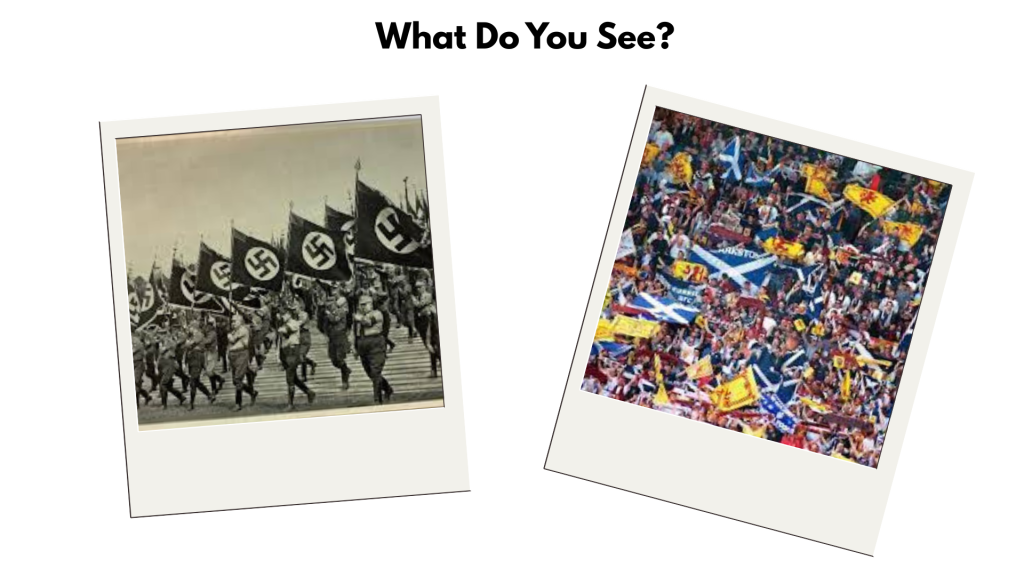
- Example: A flag at a football match may feel celebratory, whereas the same flag on a lamppost during a protest may feel intimidating.
2. Functionalism
- Functionalists focus on how symbols maintain social cohesion.
- Flags can serve as tools for shared identity, socialisation, and national unity.
- From this perspective, the Raising the Flag movement could be seen as a way to reinforce a collective sense of English or British identity, especially after political events like Brexit.
3. Marxism / Conflict Theory
- Marxist and conflict theorists examine power, inequality, and social control.
- Flags may be a symbol of dominant group identity, potentially marginalising minority groups.
- The movement can be interpreted as reflecting tensions between majority and minority populations, particularly around immigration, citizenship, and cultural dominance.
4. Feminist and Postcolonial Perspectives
- Feminist and postcolonial perspectives emphasise how symbols reflect historical power structures.
- The Union Jack is tied to the British Empire, colonial history, and gendered narratives of nationhood.
- Raising the flag can evoke pride for some and oppression for others, illustrating contested interpretations of heritage and history.
Bringing It to the Classroom: A Lesson Plan
The “Raising the Flag” movement can be used to explore identity, symbolism, and contested meanings in a way that is engaging and sensitive.
1. Starter – Personal Responses to Symbols (5 mins)
- Display the Union Jack and St George’s Cross.
- Ask students: Where do you see these flags? How do they make you feel?
2. Background Overview (10–12 mins)
- Present concise information about the movement: origins, spread, groups involved, reactions from councils, politicians, and the public.
3. Theory Focus (10 mins)
- Introduce symbolic interactionism and its focus on meaning-making through social interaction.
- Connect to other perspectives: functionalism (unity), Marxism (conflict), feminist/postcolonial (historical power).
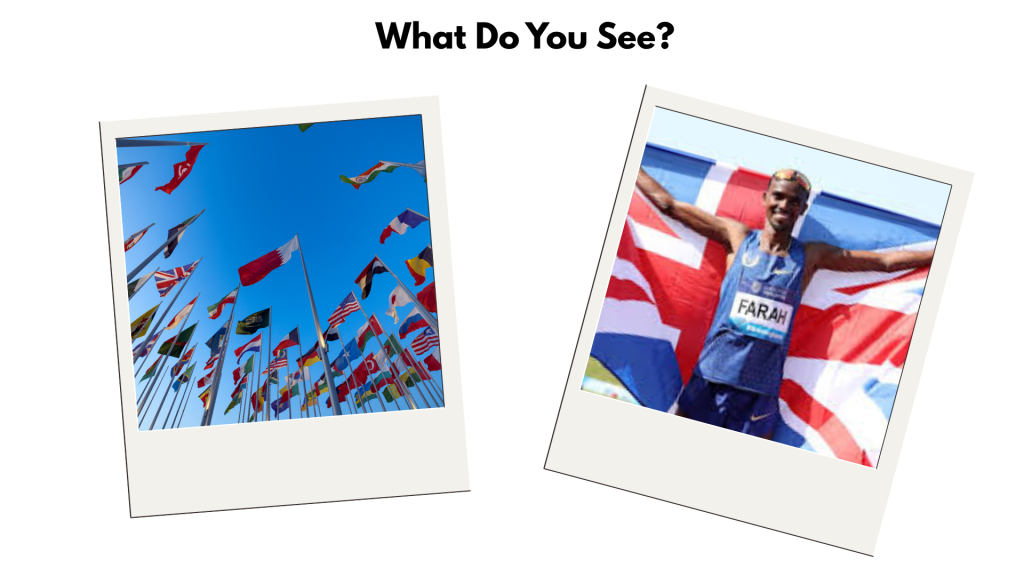
4. Activity: “What Do You See?” Image Analysis (15–20 mins) PPT included below
- Show contrasting images: political buildings, football matches, street displays, multicultural festivals.
- Students consider: meaning, inclusion/exclusion, context, and identity.
5. Guided Discussion (10 mins)
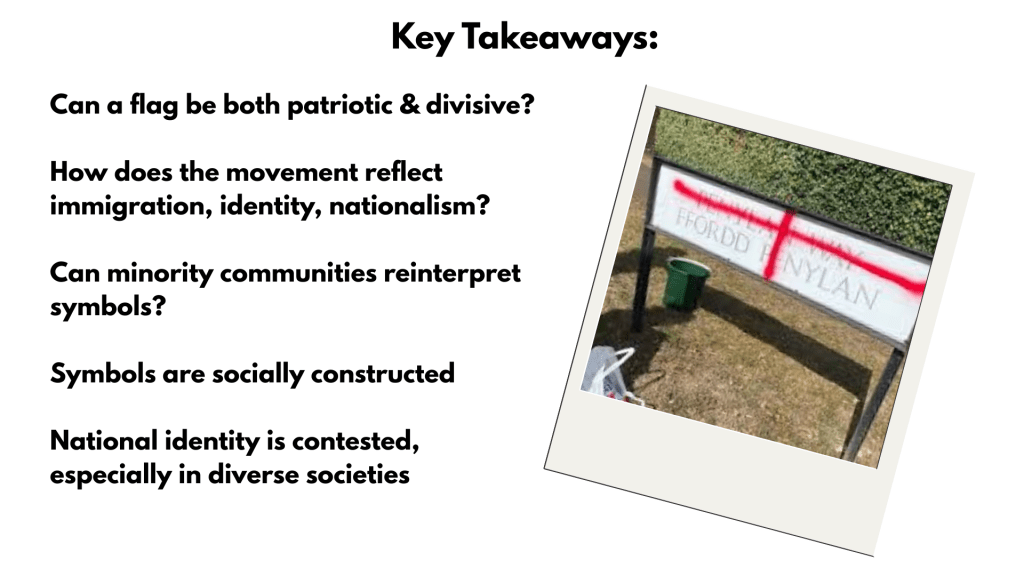
- Can a flag be both patriotic and divisive?
- How does the movement reflect broader social issues like immigration, identity, or nationalism?
- Can minority communities reclaim or reinterpret national symbols?
6. Plenary – Sociological Takeaways (5 mins)
- Symbols are socially constructed, and their meanings vary across contexts and groups.
- National identity is contested, particularly in diverse societies.
- Sociology helps students analyse and understand complex social dynamics, rather than simply judging symbols.
7. Optional Homework
- Research a media article about the movement.
- Write a short reflection applying symbolic interactionism or another sociological perspective.
Why This Lesson Works
This lesson links current events to sociological theory and research, encourages critical thinking, and gives students tools to explore identity, power, and symbolism in a diverse society. It demonstrates how sociology is rewarding yet challenging, reflecting the ever-changing social world
Below is a ready to use Powerpoint on this activity that you can download free and use in your classes.




 The Sociology Guy
Leave a comment