Weber, Max. (1922). Economy and Society: An Outline of Interpretive Sociology.

Weber’s theory of stratification: Class, Status, and Party
In contrast to Karl Marx, who viewed class conflict as the primary engine of history, Weber proposed a more complex, multi-dimensional model of social stratification.
The three dimensions of power:
- Class: Based on a person’s market situation—their economic position and life chances determined by their skills, qualifications, and the demand for them in the labour market. Weber identifies multiple class groupings, not just the two (bourgeoisie and proletariat) found in Marxist theory.
- Status: Based on social prestige, honour, or respect. Status can be influenced by class but can also exist independently, such as in the case of a respected priest with low income, or a celebrity with high income but low social respect. Status groups are often distinguished by a specific lifestyle, education, and consumption patterns.
- Party: Refers to the exercise of power through political parties, pressure groups, and other organisations. This shows that power is not just held by the economically dominant class but can be gained through other forms of association and organisation.
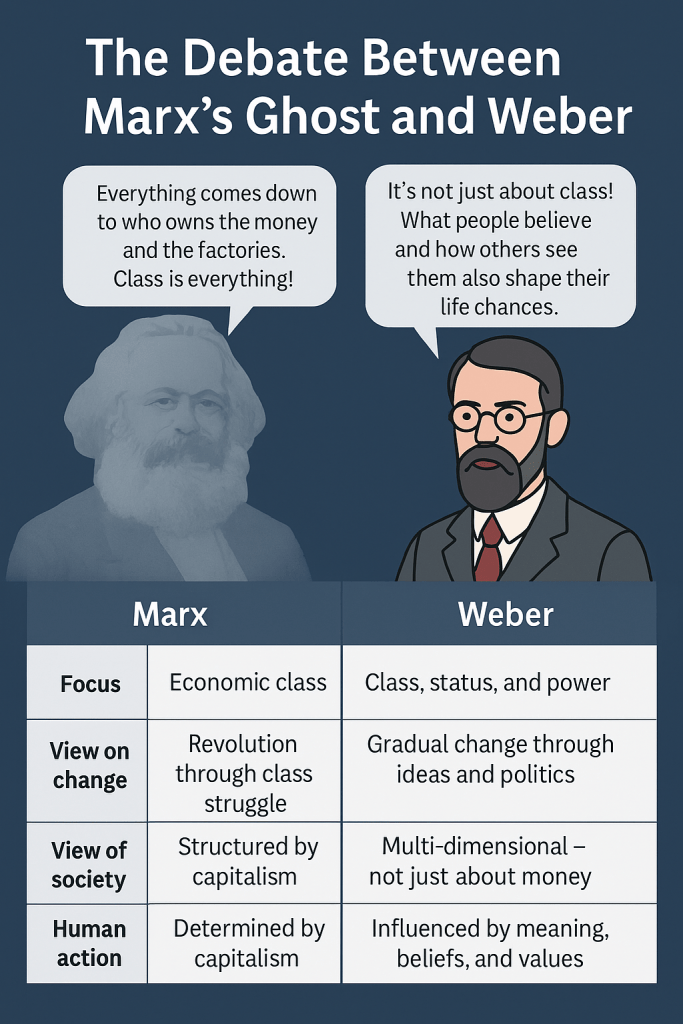
How this differs from Marx:
- Multiple sources of power: While Marx saw economic class as the single most important factor determining power, Weber argues that class, status, and party are distinct and interacting sources of power.
- Rejecting economic determinism: Weber demonstrates that social change is not purely driven by economic forces, but also by cultural ideas (like the Protestant ethic) and political factors (party).
- The “Iron Cage” vs. Revolution: While Marx saw capitalism leading to revolution, Weber saw it leading to the inescapable “iron cage” of bureaucracy and rationalisation, an outcome he saw as dehumanising.
Often this is summarised as being a debate between Weber and the Ghost of Max. This debate is summarised in the image below:
Max Weber’s work has had a profound and wide-ranging influence on many sociologists and different schools of thought, often standing in critical dialogue with—or as an alternative to—the work of Karl Marx.
Symbolic interactionism
Weber’s emphasis on social action and the subjective meanings individuals attach to their actions was foundational for the symbolic interactionist perspective.
- Alfred Schutz: This phenomenologist was heavily influenced by Weber’s interpretive sociology. He used Edmund Husserl’s phenomenology to explore the philosophical foundations of Weber’s sociology, focusing on the subjective “life-world” of individuals and clarifying Weber’s concept of verstehen.
- Peter Berger: A neo-Weberian sociologist of religion, Berger was a central figure in developing the social constructionist perspective. He adapted Weber’s ideas on secularization and disenchantment in his book The Sacred Canopy.
Structural functionalism
Surprisingly, a highly structural sociologist drew heavily on Weber.
- Talcott Parsons: As an American structural functionalist, Parsons was instrumental in introducing Weber’s work to the English-speaking world by translating some of his key texts, most famously The Protestant Ethic and the Spirit of Capitalism. He incorporated aspects of Weber’s social action theory into his own “action frame of reference,” though some critics argue he selectively interpreted Weber to fit his own structuralist agenda.
Neo-Weberianism
The most direct lineage of Weber’s work can be found in sociologists who specifically build on his multi-dimensional theory of stratification (class, status, and party) and his analysis of bureaucracy.
- John Goldthorpe: A prominent contemporary sociologist, Goldthorpe developed a sophisticated, neo-Weberian class scheme based on a person’s “market situation,” reflecting Weber’s ideas about the importance of market capacity and credentials, not just ownership.
- Frank Parkin: Known for his work on social closure, Parkin used Weber’s ideas of status and power to analyze social inequality and exclusion. He explored how groups use social closure to maintain privileges and exclude others, such as ethnic minority workers.
- Jan Pakulski and Malcolm Waters: In their work on postmodernity and inequality, these sociologists advanced a neo-Weberian analysis by arguing that class had declined in importance relative to status and consumption patterns, signaling a shift towards a more “status conventionalism”.
Critical theory
Weber’s analysis of rationalization and bureaucracy provided a basis for critical theorists, who viewed it as a dehumanizing force in modern society.
- Jürgen Habermas: This critical theorist engaged deeply with Weber’s work on rationalization. Habermas argued that Weber’s account of modernity was incomplete and sought to develop a more systematic theory of communicative action to counter the negative effects of instrumental rationality.
Other key sociologists influenced by Weber
- C. Wright Mills: This American sociologist drew upon Weber, particularly in his analysis of power elites and bureaucracy, as an alternative to the more dogmatic interpretations of Marxism.
- Robert Michels: A contemporary of Weber, Michels developed the “iron law of oligarchy” based on his studies of political parties, a theory that aligns with Weber’s concerns about the rise of bureaucratic power and the concentration of authority in the hands of a few.
A summary of Weber’s work on the Protestant Work Ethic and his work on Class, Status and Party is available to download below.
 The Sociology Guy
Leave a comment